Sentinel Surveillance Application for Adverse Events of Special Interest (AESI)
Download MarkDownThe Challenge
Following the mass rollout of COVID-19 vaccines in India, the Ministry of Health and Family Welfare (MoHFW) identified a critical need to monitor Adverse Events of Special Interest (AESIs) — medical conditions potentially associated with vaccines manufactured on new or rarely used platforms. JSIPL, through its Immunization Technical Support Unit (ITSU), was commissioned to establish a sentinel surveillance system across 16 medical colleges distributed across 13 states to identify and capture AESIs in both vaccinated and unvaccinated individuals.
Key challenges included:
- Limitations of Existing Tools: The existing data collection system was built on a third-party open-source application with significant constraints — no “Save & Draft” option, frequent data loss, inability to download custom data, and storage space issues
- Complex Clinical Forms: The surveillance required 11 interlinked forms (1 Case Screening Form and 10 Case Review Forms covering specific medical conditions), each with extensive clinical data elements
- Large File Sizes: Each case file was estimated at 20-40 MB due to required image captures of hospital records, with each image optimized to 2-4 MB
- Remote Sentinel Sites: The 16 sentinel sites were spread across 13 states (Andhra Pradesh, Assam, Delhi, Jharkhand, Karnataka, Madhya Pradesh, Maharashtra, Manipur, Odisha, Punjab, Rajasthan, Tamil Nadu, Uttarakhand) with varying connectivity levels
- Data Migration: Existing surveillance data from the legacy system needed to be migrated to the new application without loss of historical records
- Strict User Role Management: Different access levels required for Sentinel Site Officers (SSOs), Sentinel Site Associates (SSAs), Super Users, and Admin users
Velocity’s Solution
Scope of Work
Velocity developed a complete replacement for the legacy surveillance system — a custom web-based and Android application designed specifically for AESI sentinel surveillance. The application addressed all pain points of the existing system while introducing advanced capabilities for data capture, analysis, and reporting.
Key Features & Deliverables
Dual-Platform Application: Web-based application for Windows and native Android app for tablet-based field data collection
11 Interlinked Clinical Forms: 1 Case Screening Form and 10 Case Review Forms with full interlinkage, enabling comprehensive AESI documentation
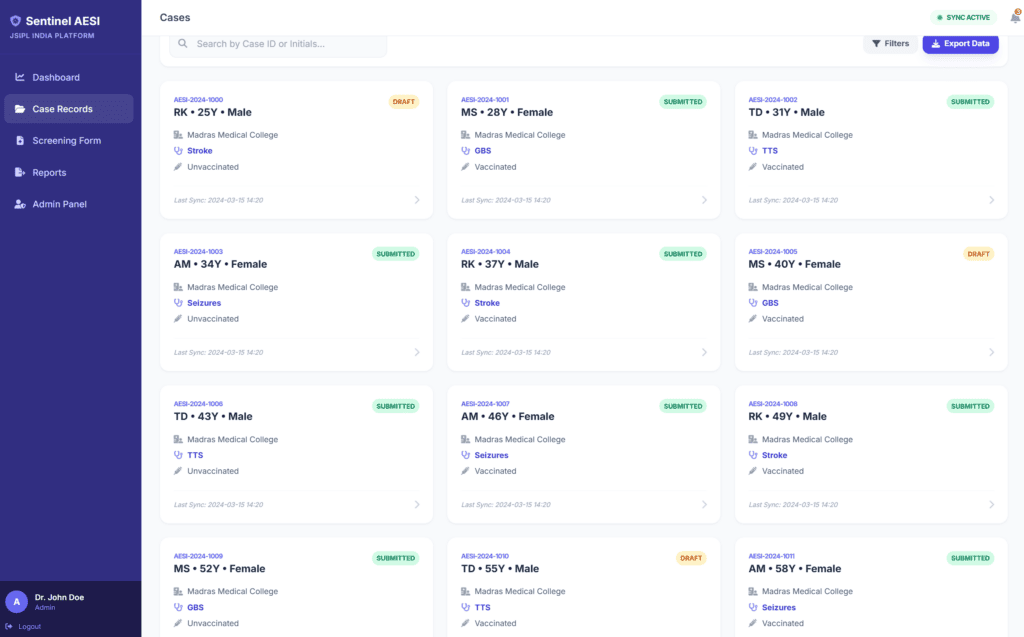
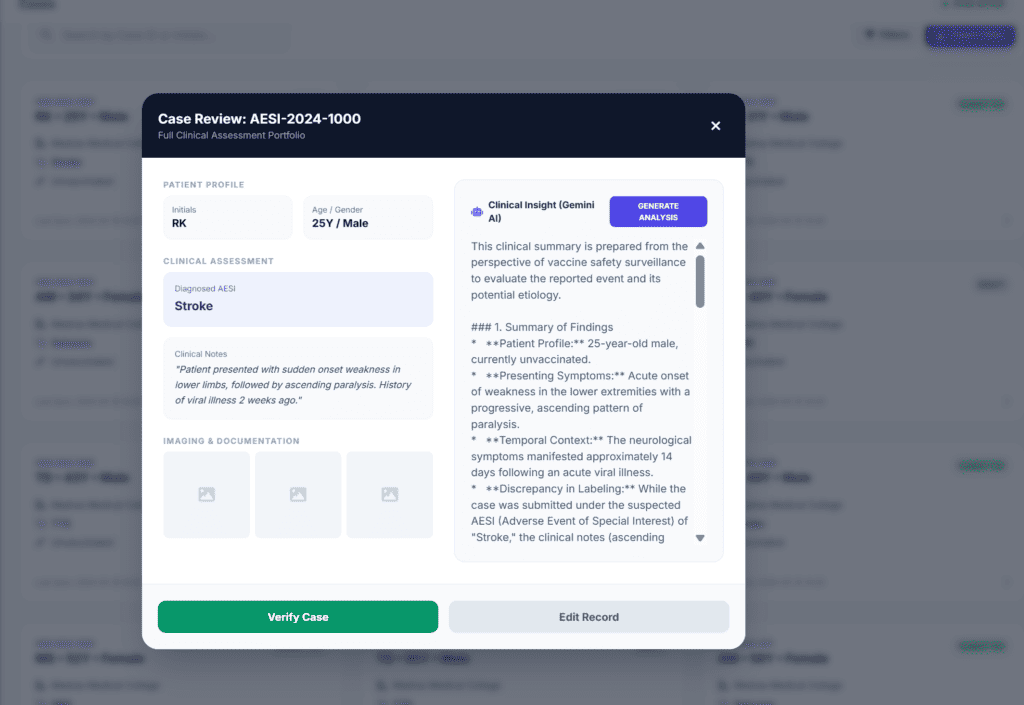
Save and Draft Functionality: Robust save and draft capability solving the primary pain point of the legacy system, preventing data loss during complex form completion
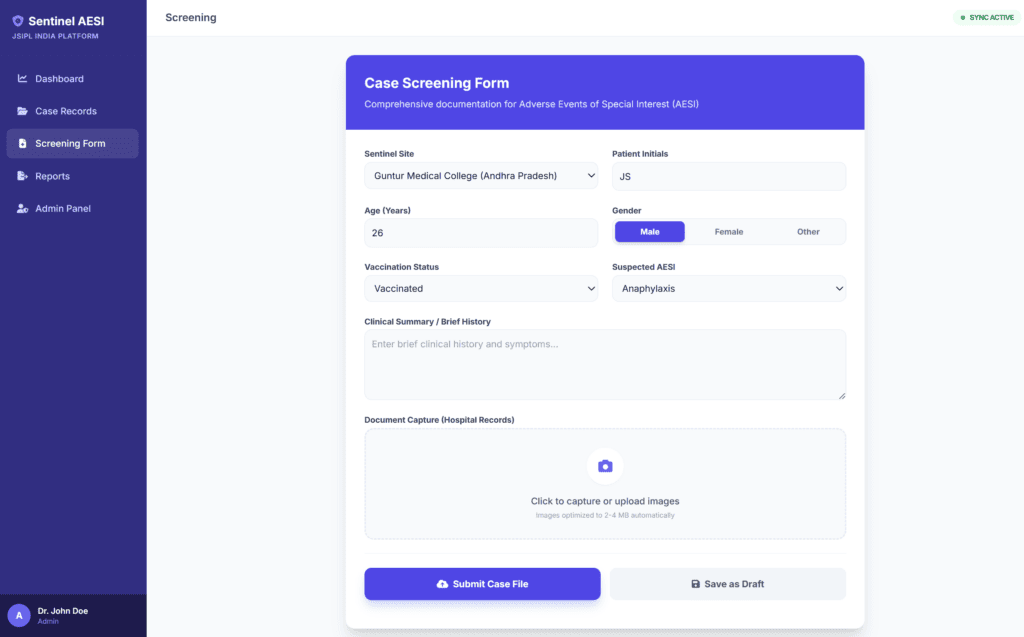
Offline-First Architecture: Complete offline data capture with automatic synchronization to the JSIPL server upon connectivity restoration
Image Capture and Optimization: In-app image capture and upload with optimization to 2-4 MB per image, coded and linked to unique case IDs for hospital record documentation
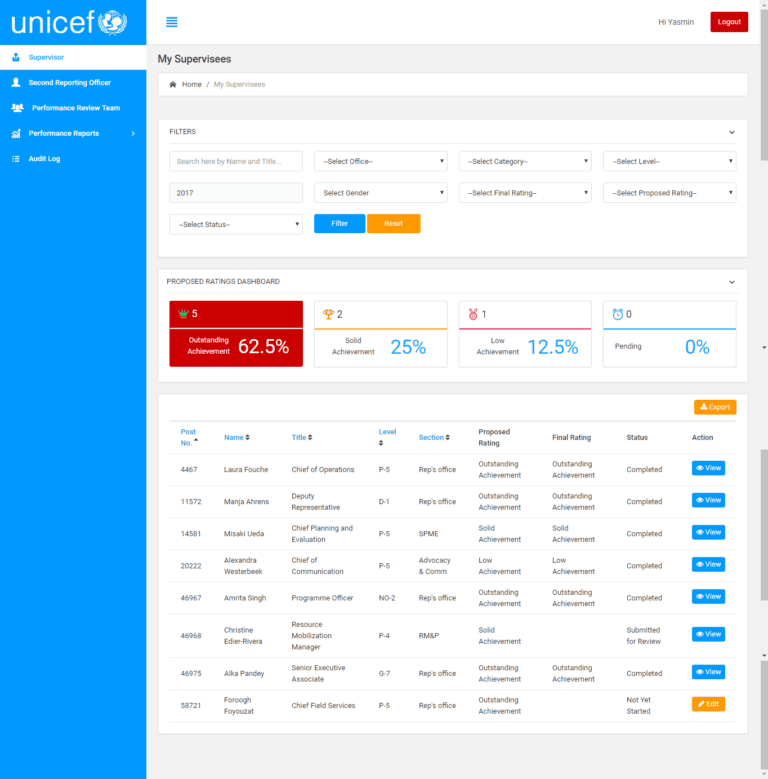
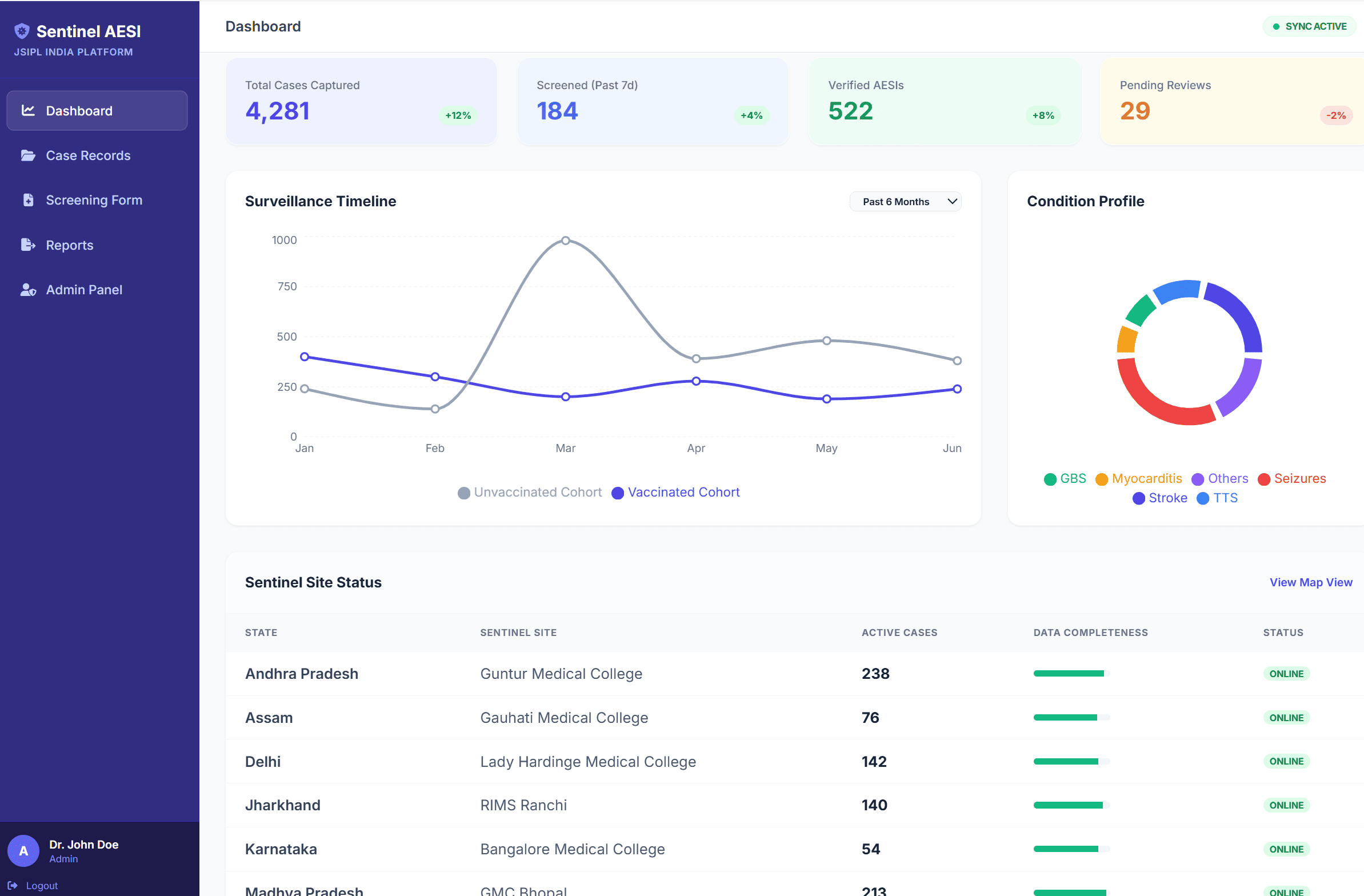
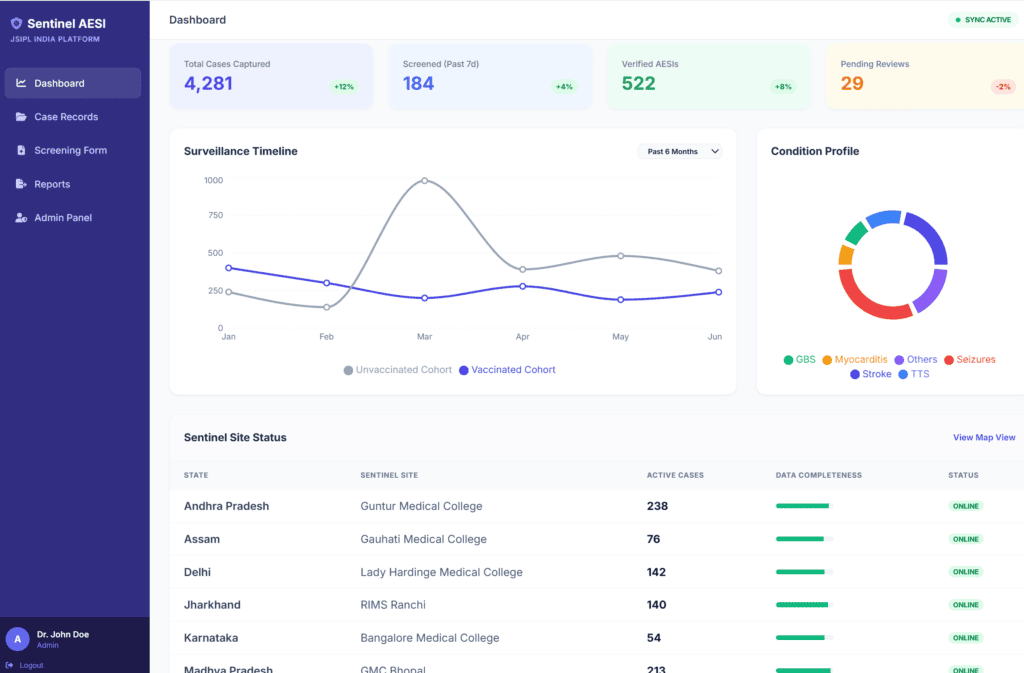
Multi-Level Dashboard: Summary tables, KPIs, geographical case representation, and demographic visualizations (age, gender, timeliness, completeness) with auto-synchronization based on real-time data upload
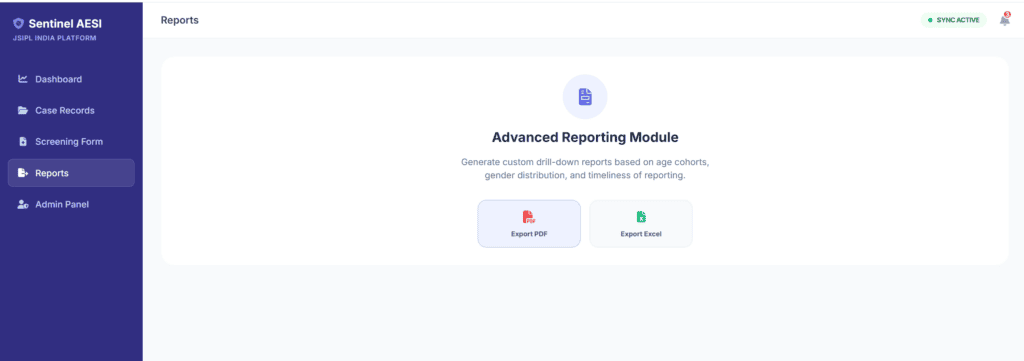
Custom Report Generation: Advanced filtering, drill-down functionality to source-level data, and database search across multiple filter
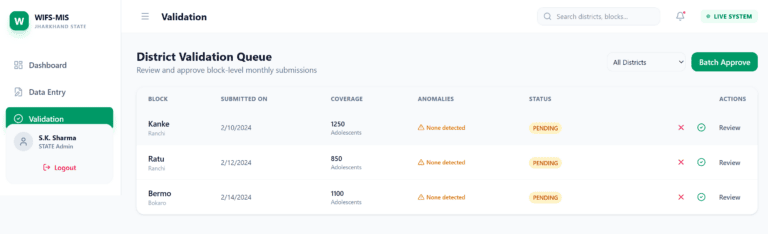
User Management System: Four-tier access control (SSOs with view/edit, SSAs with view/edit, Super Users with view/read, Admin with full permissions) with site-specific data access
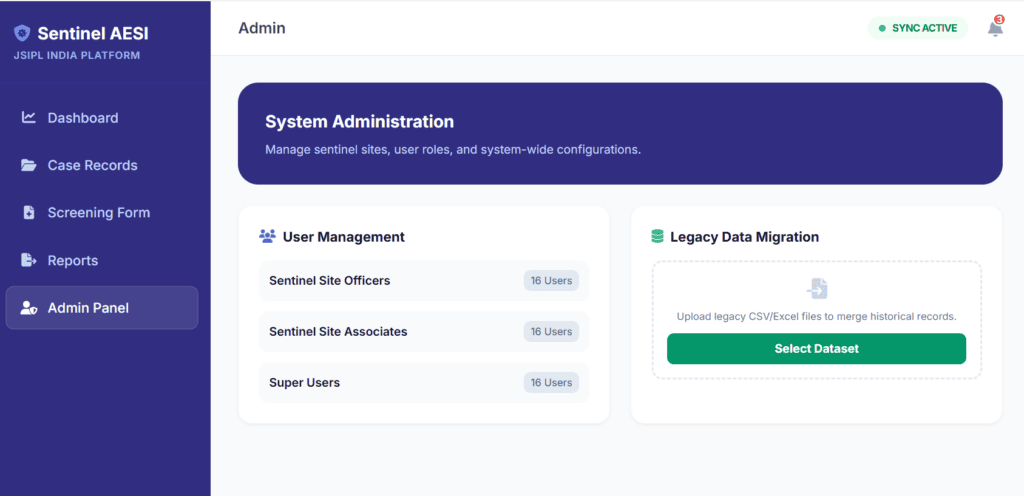
Data Migration Module: Import utility for migrating existing Excel data to the new system with dataset upload and merge capabilities for each form
Push Notifications and Alerts: Support for push notifications, alerts, and flash message
- Data Connectivity Layer: Integration with Power BI, APIs, web links, and Excel spreadsheets with secure API authentication and multi-source data triangulation
- Resolution-Independent Design: Responsive layout automatically adapting to tablets, desktops, and laptops without horizontal scrolling
Technology Stack
- Frontend: MS .NET Framework, PHP, React Native
- Backend: MS SQL Server, MongoDB
- Mobile: Native Android SDK
- Server: Windows Server 2012 R2 (HDD 2TB, NAS Drive 12TB, RAM 16GB, CPU 4-core)
- Styling: CSS-based page-tree navigation structure
- Security: Encrypted personal data, secure API authentication, JSIPL data privacy policy compliance
Implementation Approach
The project was delivered in four phases over 9 weeks, followed by an extended maintenance period:
Phase 1 – Foundation (Week 1)
– Inception report with methodology, tools, and Gantt chart
– Responsibility matrix and workflow finalization
Phase 2 – Entry-Level Reporting System (Weeks 1-4)
– User authentication with Single Sign-On and admin verification
– Development of all 11 forms (Screening + 10 Case Review Forms) in both online and offline modes
– Save and Draft functionality for offline data
– Automatic synchronization to JSIPL server
– Reporting module (essentials)
– API integration and server configuration
– Testing and bug fixing
Phase 3 – Advanced Features (Weeks 5-6)
– Bug resolution from Phase 1
– Code optimization
– Dashboard development
– Custom report generation
– Old data migration from legacy system
Phase 4 – Field Testing and Rollout (Weeks 7-9)
– Field testing across sentinel sites
– Bug fixing based on field feedback
– Application rollout and go-live
– Exit plan and handover documentation including performance test reports, security test reports, user guidelines, deployment scripts, backup processes, infrastructure design, APIs, and source codes
Maintenance Period (through December 2023)
– 8x7x365 emergency support
– Error resolution, patch deployment, updates, and upgrades
– Ongoing support for all 32 field staff (16 SSOs and 16 SSAs)
Key Outcomes & Impact
- Eliminated Legacy System Pain Points: The new system completely resolved the data loss, lack of save/draft, and storage issues that plagued the open-source predecessor
- Pan-India Surveillance Coverage: Successfully deployed across 16 sentinel sites in 13 states, providing comprehensive AESI surveillance capability
- Reliable Offline Data Capture: Field investigators could complete complex clinical forms without connectivity, with automatic synchronization ensuring no data loss
- Accelerated Data Collection: Streamlined 11-form workflow with interlinkages significantly reduced data entry time compared to the legacy system
- Successful Data Migration: Historical data from the legacy system was seamlessly migrated, preserving continuity of surveillance records
- Enhanced Vaccine Safety Monitoring: Real-time dashboards and analytics contributed to COVID-19 vaccine safety profiles and informed emerging safety issue identification
- Contribution to National Policy: Surveillance findings directly informed MoHFW’s understanding of AESI patterns in the Indian population, supporting evidence-based policy decisions
Why Velocity
Velocity was chosen for this critical COVID-19 vaccine safety surveillance project based on:
- Experience with Health Surveillance Systems: Demonstrated expertise in building data collection and surveillance applications for public health programs
- Offline-First Design Philosophy: Proven capability in developing robust offline-capable applications essential for India’s diverse connectivity landscape
- Complex Form Development: Expertise in developing interlinked clinical data forms with complex validation logic and skip patterns
- Rapid Deployment: Ability to deliver a production-ready system within 9 weeks, critical for the time-sensitive vaccine surveillance mandate
- Data Migration Expertise: Proven track record in migrating data from legacy systems while ensuring data integrity and continuity
- Collaborative Working Model: Willingness to embed dedicated resources at JSIPL and maintain close coordination with the project team throughout the engagement