Case Study: Operationalization of WIFS-MIS Platform – 2018
Download MarkDownThe Challenge
Following the initial development of the WIFS-MIS, the Government of Jharkhand needed a comprehensive operationalization effort to transform the system from a functional prototype into a fully adopted, statewide monitoring platform. The challenges included:
- Statewide Adoption: Ensuring consistent usage across all 259 blocks in 24 districts, each with varying levels of technical readiness and infrastructure
- Government Server Deployment: The system needed to be deployed on NIC (National Informatics Centre) or JAPIT (Jharkhand Agency for Promotion of Information Technology) servers, requiring compliance with strict government hosting protocols
- Training at Scale: 218 block-level health functionaries needed hands-on training in data entry, report generation, and system navigation, many of whom had limited computer proficiency
- Data Validation Workflows: Implementing a robust block-to-district validation pipeline ensuring data quality while maintaining timely reporting
- Dynamic Reporting Needs: State health leadership required dynamic graphs, charts, and reports that could be generated on-demand for programme reviews and policy discussions
- Sustainability: Building local capacity for long-term system management without continuous external technical support
- Integration with State Health Systems: Alignment with existing state health department data flows and reporting structures
Velocity’s Solution
Scope of Work
Velocity Software Solutions executed the complete operationalization of the WIFS-MIS platform, encompassing:
- Enhancement and optimization of the existing WIFS-MIS application
- Deployment on government server infrastructure (NIC/JAPIT)
- Statewide training of 218 block-level functionaries
- Development of dynamic graphs and advanced reporting module
- Block-level data entry and district-level validation workflow implementation
- One-year post-installation operations and maintenance support
Key Features & Deliverables
Enhanced Data Entry Module:
– Block-level Monthly Reporting: Structured forms for block health functionaries to enter monthly WIFS programme data including school-wise and community-wise coverage, IFA distribution, consumption tracking, and deworming statistics
- Smart Validation Engine: Multi-layered validation rules including range checks, consistency checks (coverage cannot exceed registration), mandatory field enforcement, and cross-field validation
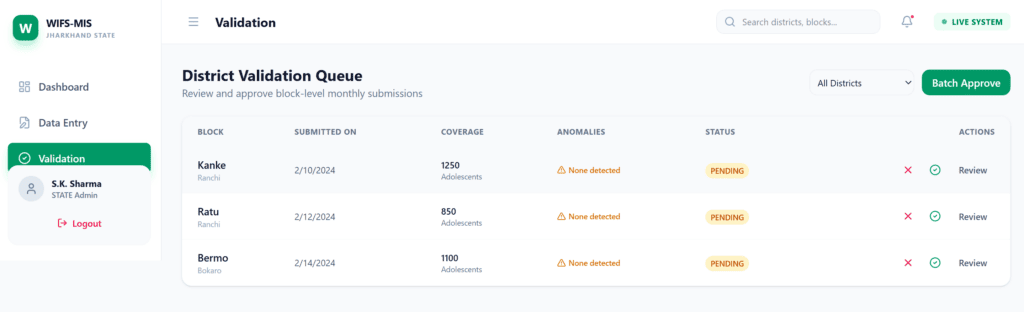
- Previous Month Carry-forward: Auto-population of static data (school lists, block details) from previous submissions to reduce data entry effort
- Multi-user Support: Concurrent access for multiple block operators with session management and data locking to prevent conflicts
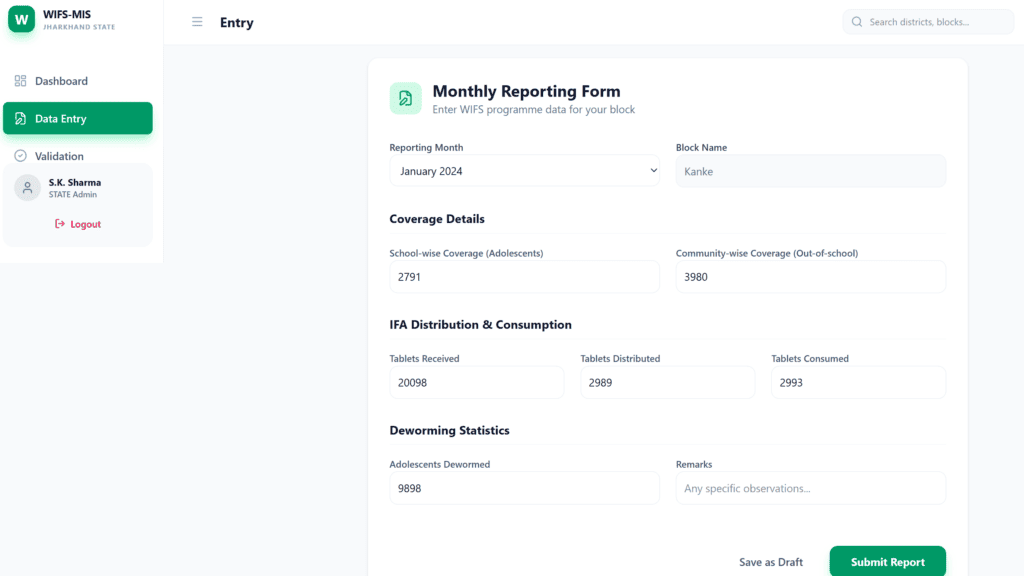
District-level Validation & Approval Workflow:
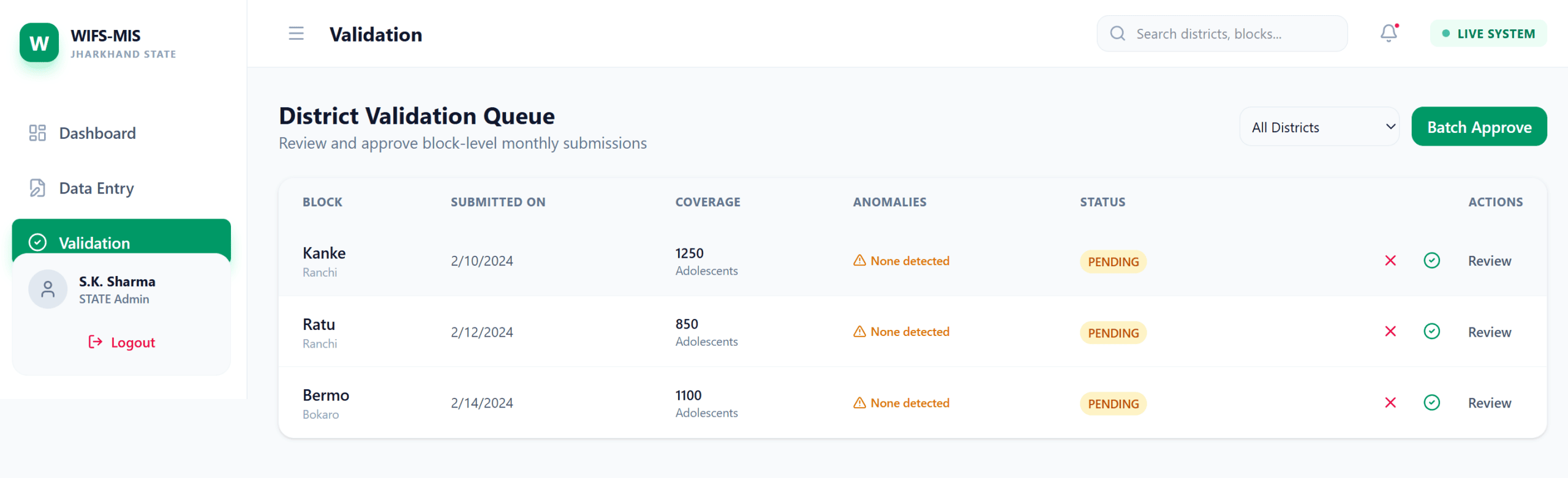
– Submission Review Interface: District health officers received a queue of block submissions for review, with automated highlighting of potential anomalies and outliers
- Rejection & Correction Cycle: Districts could reject block submissions with specific comments, triggering corrective action by block functionaries with audit trail
- Batch Approval: Efficiency features for approving multiple block submissions after review
- Deadline Management: Configurable reporting deadlines with automated reminders and escalation
Dynamic Reporting & Visualization:
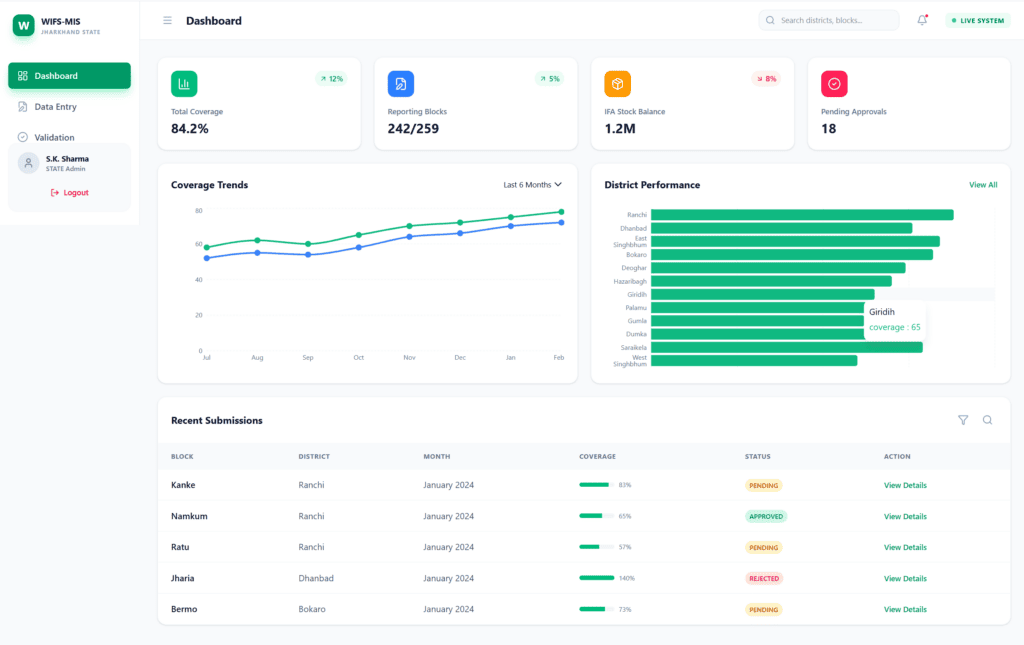
– Interactive Graphs & Charts: Bar charts, line graphs, pie charts, and stacked charts for key WIFS indicators, dynamically generated based on user-selected parameters (time period, geography, indicator)
- District Comparison Views: Side-by-side comparison of programme performance across districts with ranking and benchmarking
- Trend Analysis: Month-over-month and year-over-year trend lines for tracking programme progress
- Drill-down Capability: State-to-district-to-block drill-down in all visualizations
- Export & Print: All reports and graphs exportable in PDF, Excel, and image formats for offline use in meetings and presentations
Stock & Supply Chain Monitoring:
– IFA Tablet Stock Register: Digital tracking of IFA tablet receipts, issues, consumption, and balance at block and district levels
– Threshold Alerts: Configurable minimum stock level alerts triggering notifications to district and state supply chain teams
– Expiry Tracking: Batch-wise expiry date tracking to prevent wastage and ensure timely utilization
Government Server Deployment:
– NIC/JAPIT Compliance: Application deployed on government-approved infrastructure with all security hardening, firewall configuration, and access policies compliant with state IT standards
- SSL/TLS Encryption: Secure data transmission between users and servers
- Database Backup: Automated daily database backups with documented recovery procedures
- Performance Optimization: Server-side caching and query optimization for smooth performance across low-bandwidth connections
Technology Stack
- Frontend: HTML5, CSS3, JavaScript, jQuery, Chart.js/Highcharts for dynamic graphs
- Backend: PHP / ASP.NET
- Database: MySQL / MS SQL Server
- Charts & Visualization: Dynamic charting library for interactive graphs
- Server: NIC / JAPIT government infrastructure
- Security: SSL/TLS, role-based access, input sanitization, encrypted credentials
Implementation Approach
System Enhancement (Month 1): Reviewed and enhanced the existing WIFS-MIS application based on field feedback and state health department requirements. Developed the dynamic reporting module with interactive graphs. Implemented the district validation workflow and stock monitoring features.
Government Server Deployment (Month 1-2): Coordinated with NIC/JAPIT for server provisioning and configuration. Deployed the application with all security measures, SSL certificates, and firewall rules. Conducted performance testing and optimization on government infrastructure. Set up automated backup schedules and monitoring.
Statewide Training (Month 2-3): Organized training workshops for 218 block-level health functionaries across multiple batches. Covered data entry procedures, validation rules, report generation, and troubleshooting. Developed and distributed training manuals and quick-reference guides in Hindi. Conducted separate training for district-level validators and state-level administrators.
Phased Rollout (Month 2-3): Initiated data entry in pilot blocks with close monitoring and support. Progressively expanded to all 259 blocks across 24 districts. Established support channels (phone, email) for issue resolution during rollout.
Post-installation Support (12 months): Dedicated support team for bug fixes, performance monitoring, and user assistance. Monthly system health checks and performance reports. Feature enhancements based on user feedback and evolving programme requirements. Periodic refresher training sessions.
Key Outcomes & Impact
- Statewide Operationalization: Successfully deployed and operationalized the WIFS-MIS across all 259 blocks in 24 districts of Jharkhand, creating a comprehensive digital monitoring ecosystem
- 218 Functionaries Trained: Capacity building of 218 block-level health functionaries in digital data entry and reporting, contributing to the state’s digital health infrastructure readiness
- Real-time Programme Monitoring: State and district health officials gained real-time visibility into WIFS programme implementation through dynamic dashboards, replacing delayed paper-based reports
- Improved Data Quality: Multi-layered validation and district-level approval workflow significantly enhanced the accuracy and reliability of programme data
- Evidence-based Programme Management: Dynamic graphs and drill-down reports empowered state leadership to identify underperforming areas and make data-driven resource allocation decisions
- Stock Optimization: Digital stock tracking reduced IFA tablet stockouts and wastage through timely alerts and proactive redistribution
- Government Ownership: Deployment on NIC/JAPIT servers with comprehensive training ensured long-term government ownership and sustainability of the platform
- Programme Coverage Improvement: With better monitoring, the WIFS programme in Jharkhand saw improved reporting compliance and programme coverage rates
Why Velocity?
Velocity Software Solutions was entrusted with this critical health programme operationalization based on our:
- Proven expertise with the WIFS-MIS platform built on our previous work developing the initial system in 2017
- Strong experience in government server deployments with compliance to NIC/JAPIT hosting requirements and security standards
- Demonstrated capacity building capabilities for training large numbers of government functionaries with varying technical proficiency
- Track record in health programme MIS platforms across multiple states and national programmes
- Commitment to long-term support through dedicated post-installation maintenance ensuring sustained system adoption
- Deep partnership with UNICEF India spanning multiple projects in Jharkhand and across India
Velocity Software Solutions specializes in operationalizing health information systems at scale, ensuring that technology investments translate into improved programme outcomes and better health for communities across India.