UNICEF New Delhi – FSSM Monitoring Dashboard for Four States
Download MarkDown
The Challenge
India achieved significant progress under the Swachh Bharat Mission Phase 1 (2014-2019) in increasing access to toilet facilities. However, safe management of faecal sludge generated in toilets remained a critical issue, especially given that only 40% of urban India is connected to sewer networks, with approximately 60% of toilets relying on on-site sanitation systems (OSS) such as septic tanks and pit latrines.
Key challenges included:
- No Dedicated FSSM Monitoring: While India had dashboards for SBM (Grameen) capacity building and SBM (Urban) toilet infrastructure, there was no dashboard monitoring the safe management of faecal sludge matter — a critical gap in the monitoring architecture
- Fragmented Data: FSSM data across community, Urban Local Body (ULB), and Faecal Sludge Treatment Plant (FSTP) levels was scattered and not systematically collected or visualized
- Multi-State Complexity: Four states (Assam, Jharkhand, Madhya Pradesh, and Chhattisgarh) each had unique FSSM contexts requiring state-specific dashboard configurations
- Multi-Level Monitoring Needs: Monitoring was needed at multiple levels — household/community level (septic tank desludging), ULB level (service tracking), state level (policy and planning), and FSTP/STP level (plant functionality and capacity)
- IoT Integration Requirement: FSTP-level monitoring required exploration of IoT integration with sensors to track plant functionality in real-time
- Government Handover: The system needed to be eventually migrated to government (NIC) infrastructure in all 4 states
Velocity’s Solution
Scope of Work
Velocity Software Solutions was engaged to establish a comprehensive IT-enabled structure for monitoring FSSM processes across four states, encompassing dashboard development, portal creation for external monitoring, and end-to-end IT solution delivery.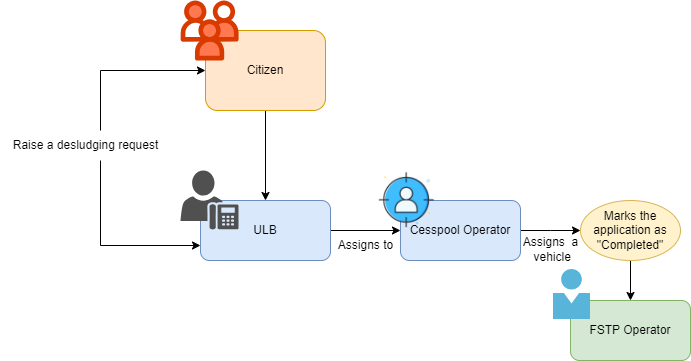
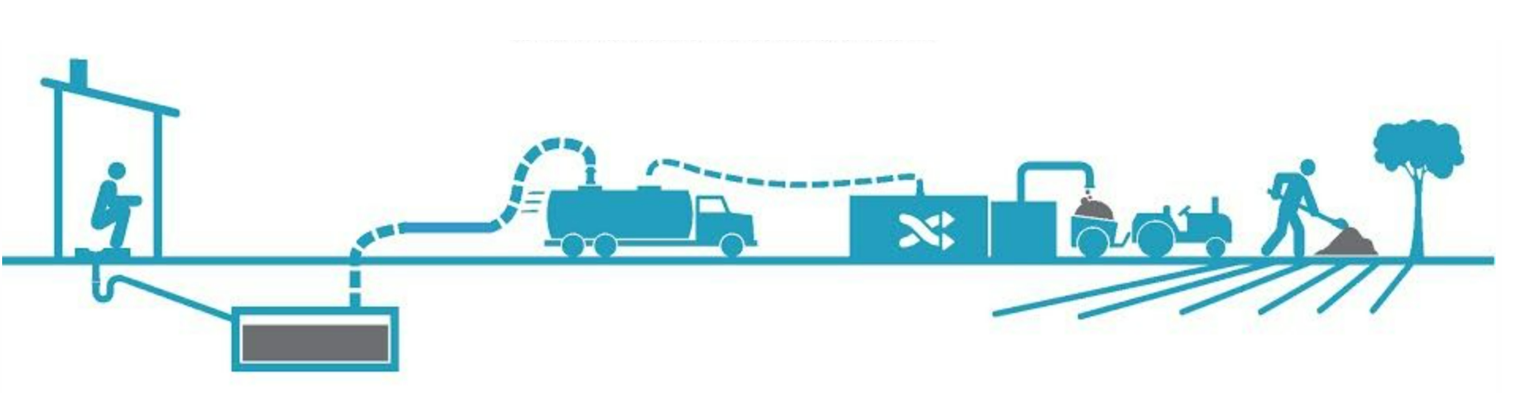
Fig: FSSM Process Flowchart
Key Features & Deliverables
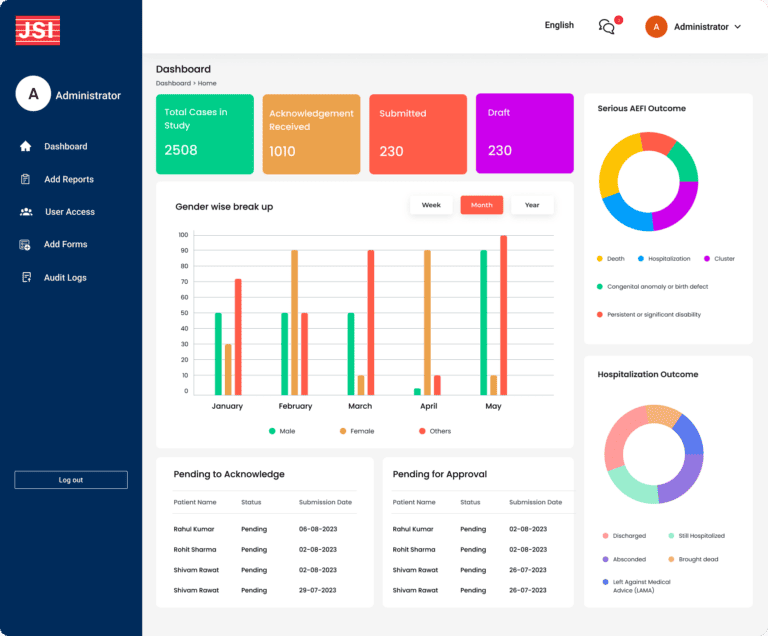
State-Level FSSM Dashboard
– State-specific FSSM dashboards accessible to government department officials managing FSM projects
– Key indicators captured across all four states based on baseline assessment data
– Literature review of the FSSM sector to identify relevant monitoring indicators
– Stakeholder meetings with UNICEF state teams, government counterparts, and Technical Support Units 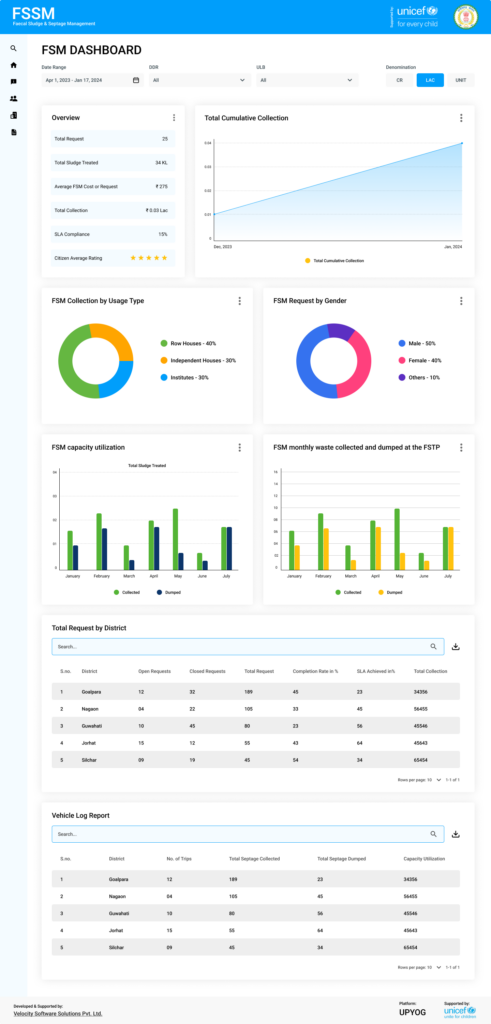
Fig: FSSM Dashboard for Government Level Officials
Community/Household Level Monitoring Portal
– Septic tank desludging status tracking at selected ULB levels
– De-sludger mobile application for operation tracking
– Call center integration for centralized desludging request registration
– Online payment linkage for monitoring revenue collection
– Regular cleaning and maintenance monitoring of septic tanks
– User fee and sanitation tax payment tracking
– Training modules for ULB-level officials on community-level interfaces
ULB Level Monitoring Dashboard
– Complete website with reporting and dashboard management system for state governments
– Tracking and recording data for each septic tank for effective desludging planning
– GPS-enabled live desludging vehicle tracking system
– FSTP capacity planning and prospective planning support
– Revenue collection monitoring through payment linkages
– Grievance Redressal Mechanism for ULB communication with state nodal bodies
FSTP/STP Level Monitoring
– IoT integration exploration with sensors for real-time FSTP functionality monitoring
– Data capture through sensors in an integrated system for FSTP managers
– Capacity monitoring to support planning for new FSTPs or upgradation of existing ones
– Monthly payment status tracking linked to onsite TSU teams
– Monitoring forms/mobile app for desludging operations (trips, volume of septage emptied)
– Data transmission and reflection in state-level dashboards
Comprehensive IT Solution
– End-to-end design, development, testing, deployment, and Go-Live
– Data flow architecture with clear flow charts across fields and levels
– Functional specification documents from requirements gathering
– Solution architecture, UI/UX mockups, project plans, and QA/test plans
– Domain name registration and management
– Vulnerability Assessment and Penetration Testing (VAPT) through independent specialized agency
– Role-based access control with special consideration for personally identifiable information
– Workflow-driven approach with streamlined monitoring and end-to-end tracking
Handover & Knowledge Transfer
– Complete source code, libraries, and packages with clear migration instructions
– Code documentation and user manuals for administrators and end users
– Fully functional dashboard image configured on UNICEF cloud for future demos and enhancements
– Training programme and handover documentation for technical and business perspectives
– 8 months of system operation followed by handover to respective government agencies in all 4 states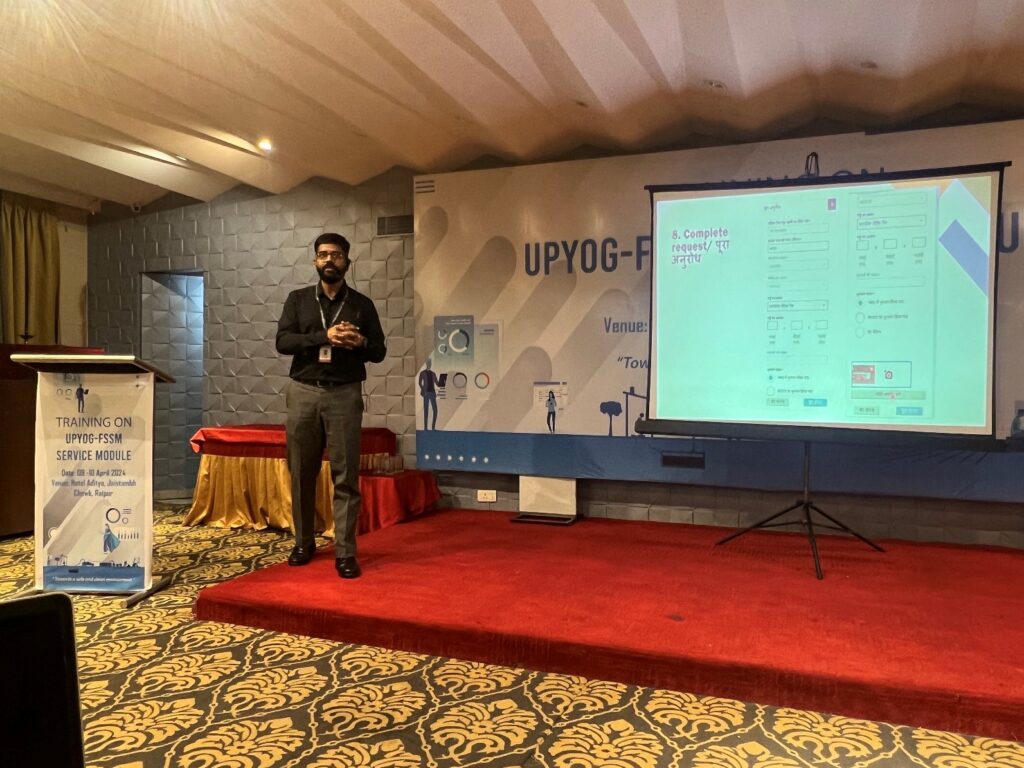
Fig: Training Sessions
Technology Stack
- Frontend: Responsive web dashboard, Mobile applications
- Backend: API-driven architecture with multi-level data aggregation
- IoT: Sensor integration for FSTP monitoring
- GPS: Live vehicle tracking for desludging operations
- Communication: Call center integration, SMS/notification services
- Security: VAPT-certified, SSL, role-based access control, PII protection
- Infrastructure: Cloud-based with migration path to NIC/government servers
- Licensing: AGPL license with publicly available source code
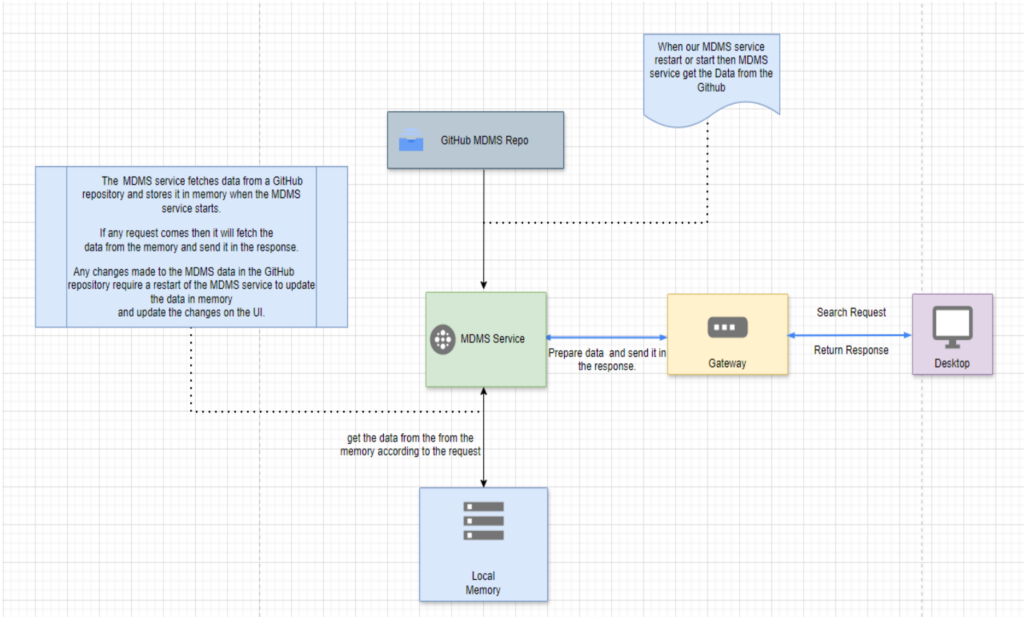
Fig: Technical Architecture
Implementation Approach
The project was structured around four major deliverable areas over 8 months:
Phase 1 – State Dashboard Development (Months 1-2): Review of existing FSSM systems across states and partner organizations, stakeholder meetings with state urban development departments/ULBs and UNICEF/TSU teams, and creation of the state-level dashboard with key indicators.
Phase 2 – External Monitoring Portal Development (Months 1-6): Parallel development of community-level, ULB-level, and FSTP/STP-level monitoring portals with progressive testing and deployment across 4 states. Travel to all 4 states was required for testing modules and applications.
Phase 3 – Comprehensive IT Support (Months 1-6): End-to-end IT solution delivery including requirements gathering, architecture design, development, testing, VAPT, and deployment. Comprehensive documentation maintained throughout.
Phase 4 – Handover & Knowledge Transfer (Month 7-8): System operation, monitoring dashboard architecture report with source codes, handover process with required certifications, and transfer to government agencies.
The work was supervised by the WASH Officer for M&E, with technical support from the IT team and WASH Sanitation Specialist at the UNICEF Delhi office, in collaboration with respective UNICEF state offices in Assam, Jharkhand, Madhya Pradesh, and Chhattisgarh.
Key Outcomes & Impact
- First-of-Its-Kind FSSM Dashboard: Created India’s first dedicated monitoring dashboard for Faecal Sludge and Septage Management, filling a critical gap in the national sanitation monitoring architecture
- Four-State Coverage: Deployed across Assam, Jharkhand, Madhya Pradesh, and Chhattisgarh, catalyzing the potential for pan-India FSSM monitoring
- Multi-Level Monitoring: Enabled monitoring at community, ULB, state, and FSTP levels, providing a comprehensive view of the FSSM value chain
- SDG Contribution: Supported India’s progress toward SDG 6 (Clean Water and Sanitation) targets by 2030
- Government Capacity Building: Transferred technology and knowledge to state government agencies for sustainable operation
- Data-Driven Policy: Empowered state urban development departments with data-driven insights for FSSM planning, resource allocation, and grievance redressal
Why Velocity
Velocity Software Solutions was selected for this pioneering FSSM monitoring project because of:
- WASH Sector Understanding: Demonstrated knowledge of the WASH sector, particularly sanitation systems and faecal sludge management
- Dashboard Development Expertise: Proven track record in developing multi-level government monitoring dashboards
- IoT and Mobile Integration Capabilities: Technical competence in IoT integration, GPS tracking, and mobile application development
- Multi-State Implementation Experience: Ability to manage parallel deployments across multiple states with different contexts and requirements
- Government Interoperability: Experience in developing systems compatible with NIC infrastructure and government data standards
- Open Source Commitment: All software conforming to AGPL license with publicly available source code, aligning with UNICEF’s open-source mandate
- Security Compliance: Capability to facilitate VAPT through independent agencies and implement comprehensive security frameworks