UNICEF Jharkhand – Child Protection MIS Enhancement & Government Server Migration
Download MarkDownThe Challenge
The monitoring and review mechanism for child protection systems in Jharkhand required a robust, real-time Management Information System. The CP MIS, developed in 2016-17, covered multiple child protection bodies:
- Child Welfare Committees (CWC): Responsible for care and protection of children in need
- Juvenile Justice Boards (JJB): Handling cases of children in conflict with law
- Child Care Institutions (CCI): Including Specialized Adoption Agencies
- Special Juvenile Police Units (SJPU): Police units dedicated to children’s cases
- District Child Protection Society (DCPS): Coordinating child protection services at district level
While the CP MIS was in use across these bodies, several gaps had been identified:
- Functional Issues: Identified gaps in the system’s functionality that impeded effective monitoring and review
- Government Hosting Requirement: The Department of Women, Child Development (DWCD) had agreed to host the CP MIS on government servers for sustainability, but the system needed to meet government security and compatibility standards
- Security Audit Compliance: Before migration to government servers, the system required a security audit by a CERT (Computer Emergency Response Team) empaneled agency of NIC (National Informatics Centre)
- Knowledge Transfer Need: Government trainers and officials needed formal training to independently manage and operate the system
- Sustainability Concerns: Transitioning ownership to the government required comprehensive documentation and capacity building
Velocity’s Solution
Scope of Work
Velocity undertook a comprehensive engagement to review, enhance, secure, and migrate the CP MIS from UNICEF-managed infrastructure to the Government of Jharkhand’s servers, ensuring full functionality and sustainability.
Key Features & Deliverables
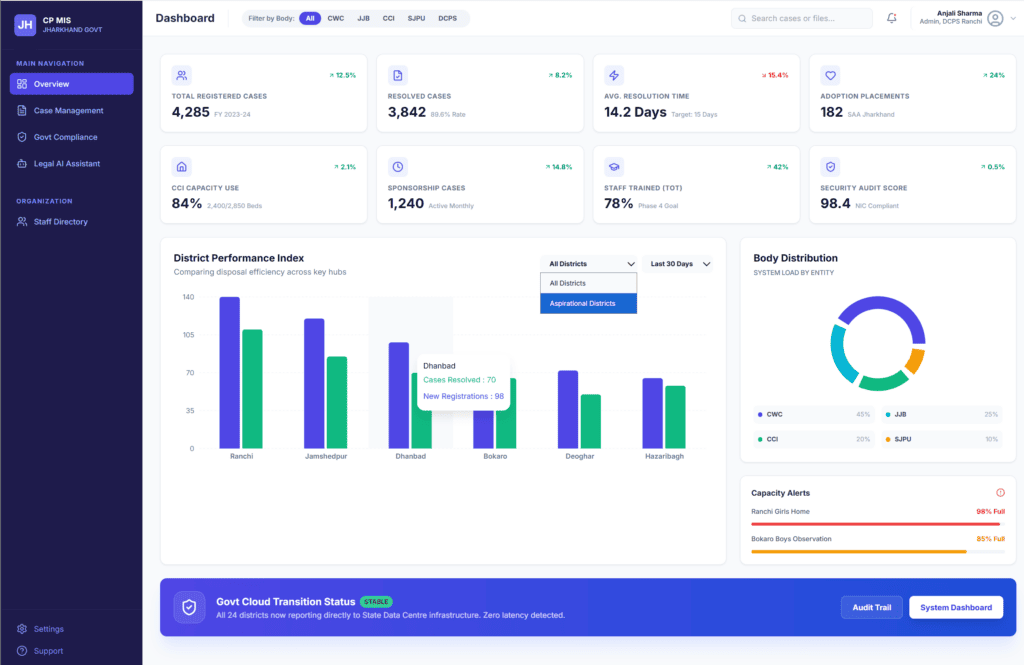
- Software Enhancement: Addressed identified issues and gaps in the CP MIS to improve its functionality and robustness. Modifications included:
- Bug fixes for known functional issues
- Performance optimization
- User interface improvements based on user feedback
Data quality enhancements
Third-Party Security Audit:
- Facilitated security audit through CERT empaneled agency of NIC
- Implemented modifications based on security audit findings
- Conducted re-audit as necessary until compliance was achieved
Ensured the system met government security standards for hosting on government servers
Government Server Migration:
- Ensured CP MIS technical compatibility with government server infrastructure
- Executed successful transfer of the complete system including database, application code, and configurations
Tested all functionalities post-migration to confirm zero data loss and full operational capability
Training of Trainers (ToT):
- Conducted comprehensive ToT sessions for district and state trainers/officials
- Developed training materials and user guides
- Built capacity for government staff to independently operate and manage the system
Technology Stack
- Web-based application (existing system enhancement)
- Government server infrastructure (post-migration)
- Database management system
- Security testing tools (CERT compliant)
- NIC-standard deployment environment
Implementation Approach
The project was executed in four sequential phases over 60 days:
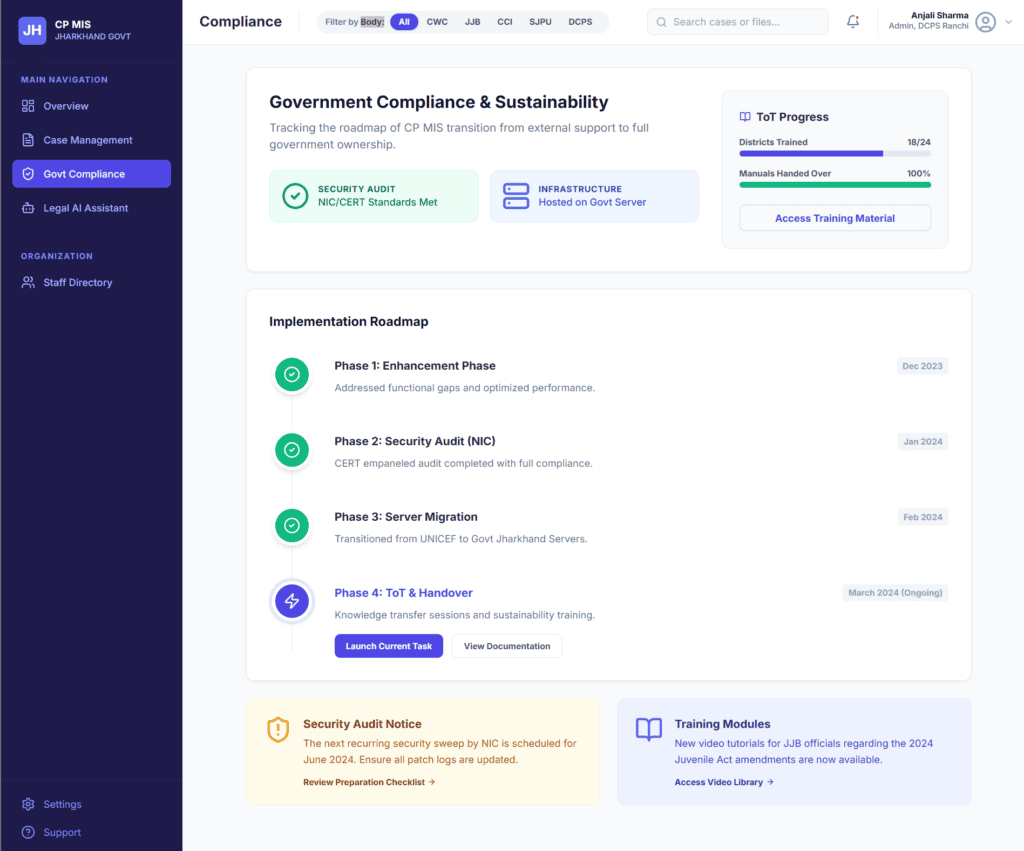
Enhancement Phase: Reviewed the existing CP MIS, identified and prioritized issues, implemented software modifications to address functional gaps and improve system robustness.
Security Audit Phase: Engaged CERT empaneled agency of NIC for third-party security audit. Implemented all recommended security modifications and facilitated re-audit until the system achieved full compliance with government security standards.
Migration Phase: Verified technical compatibility with government servers, executed the migration including database transfer and application deployment, and conducted comprehensive post-migration testing of all functionalities.
Training & Handover Phase: Conducted Training of Trainers (ToT) sessions for district and state officials, provided three months of handholding support during the transition period, and delivered all documentation and system artifacts.
The project was supervised by UNICEF’s Child Protection Specialist with quarterly performance reviews.
Key Outcomes & Impact
- Government Ownership: Successfully transitioned the CP MIS from UNICEF-managed infrastructure to government servers, establishing government ownership and long-term sustainability.
- Security Compliance: Achieved CERT/NIC security audit compliance, ensuring the system met government standards for hosting sensitive child protection data.
- Improved Functionality: Addressed known system issues, delivering a more robust and user-friendly CP MIS for child protection stakeholders across Jharkhand.
- Institutional Capacity: ToT sessions equipped district and state officials with the knowledge to independently manage and operate the CP MIS, reducing dependency on external technical support.
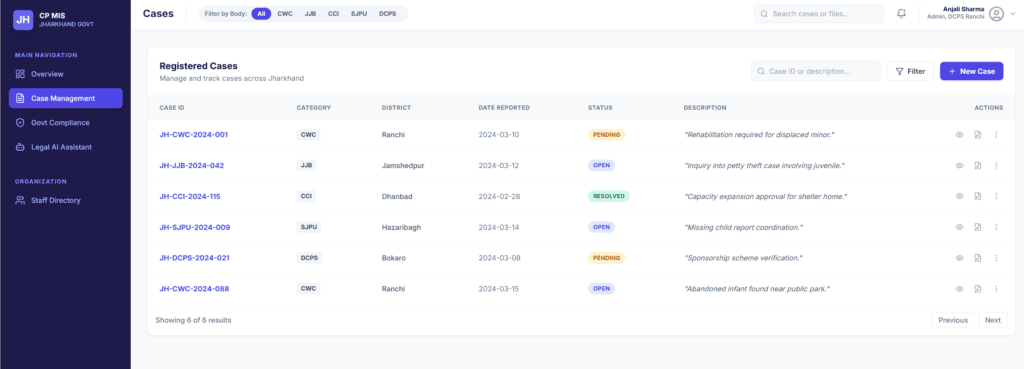
- Real-Time Monitoring: Enhanced system enabled CWCs, JJBs, CCIs, SJPUs, and DCP societies to report and monitor child protection cases in real-time.
- Sustainability Model: Demonstrated a replicable model for transitioning UNICEF-supported digital tools to government ownership in other states and sectors.
Why Velocity
Velocity was engaged under UNICEF’s existing LTA based on:
- Government System Experience: Proven track record of developing and deploying software on government infrastructure, including experience with NIC standards and CERT security requirements.
- CP MIS Domain Knowledge: Understanding of child protection monitoring systems and the Juvenile Justice framework in India.
- Web Application Expertise: Strong capabilities in web-based application development, enhancement, and maintenance.
- Migration Competency: Experience in system migration between different hosting environments while ensuring data integrity and zero downtime.
- Training & Capacity Building: Demonstrated ability to design and deliver effective Training of Trainers programmes for government stakeholders.