Case Study: Weekly Iron and Folic Acid Supplementation (WIFS) MIS – 2017
Download MarkDownThe Challenge
Jharkhand’s WIFS programme covers hundreds of blocks across the state, with data flowing from schools and Anganwadi centers through blocks to the district and state level. The key challenges included:
- Paper-based Reporting: Block-level data on WIFS implementation was being collected through paper registers, leading to delays in data aggregation and significant reporting gaps
- Lack of Real-time Visibility: State and district health officials had no real-time view of programme coverage, supplement consumption rates, or stock positions across blocks
- Multi-level Data Flow: Data needed to flow from block to district to state with appropriate validation and approval at each level, requiring a structured workflow
- Stock Management Gaps: IFA tablet stock positions at block and district levels were not being tracked systematically, leading to stockouts in some areas and expiry in others
- Limited Technical Capacity: Block-level functionaries had limited computer literacy, requiring an extremely user-friendly interface
- Timely Alerts: There was no mechanism for automated alerts when blocks missed reporting deadlines, stocks fell below threshold levels, or coverage dropped significantly
Velocity’s Solution
Scope of Work
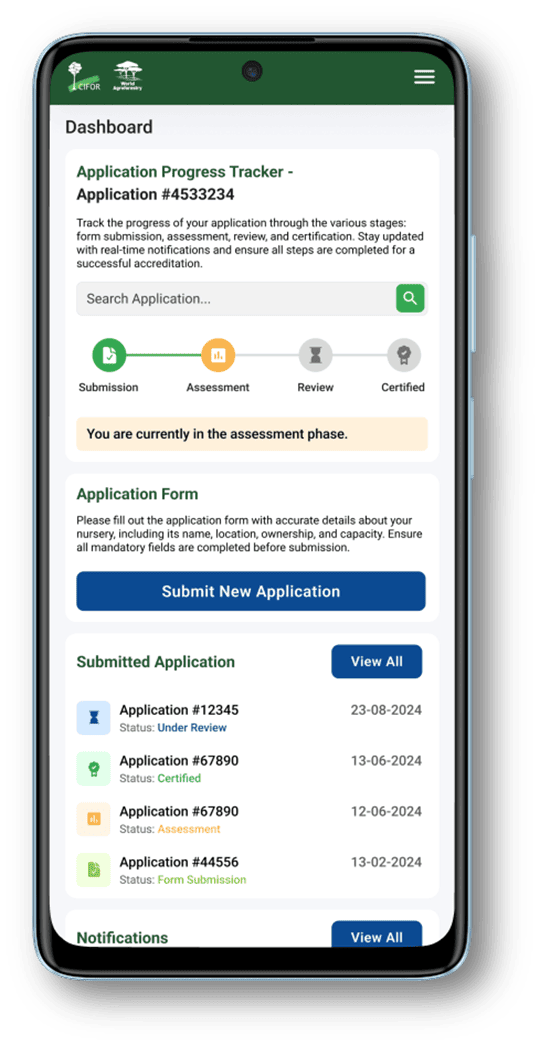
Velocity Software Solutions developed and deployed an upgraded online WIFS Management Information System (MIS) with the following components:
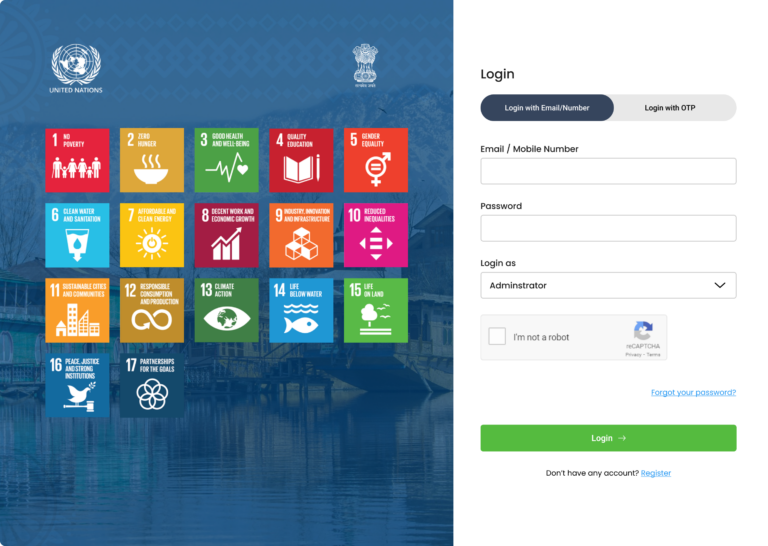
- Block-level data entry module with validation rules
- District-level validation and approval workflow
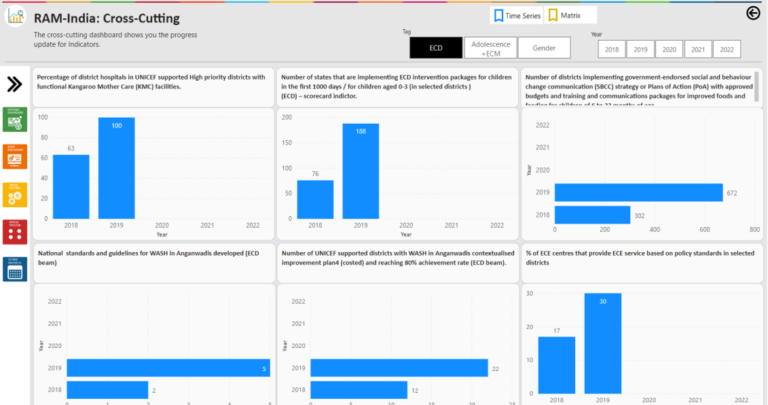
- State-level dashboard with aggregated analytics
- Stock position monitoring and alert system
- SMS and email notification engine
- Report generation and export capabilities
Key Features & Deliverables
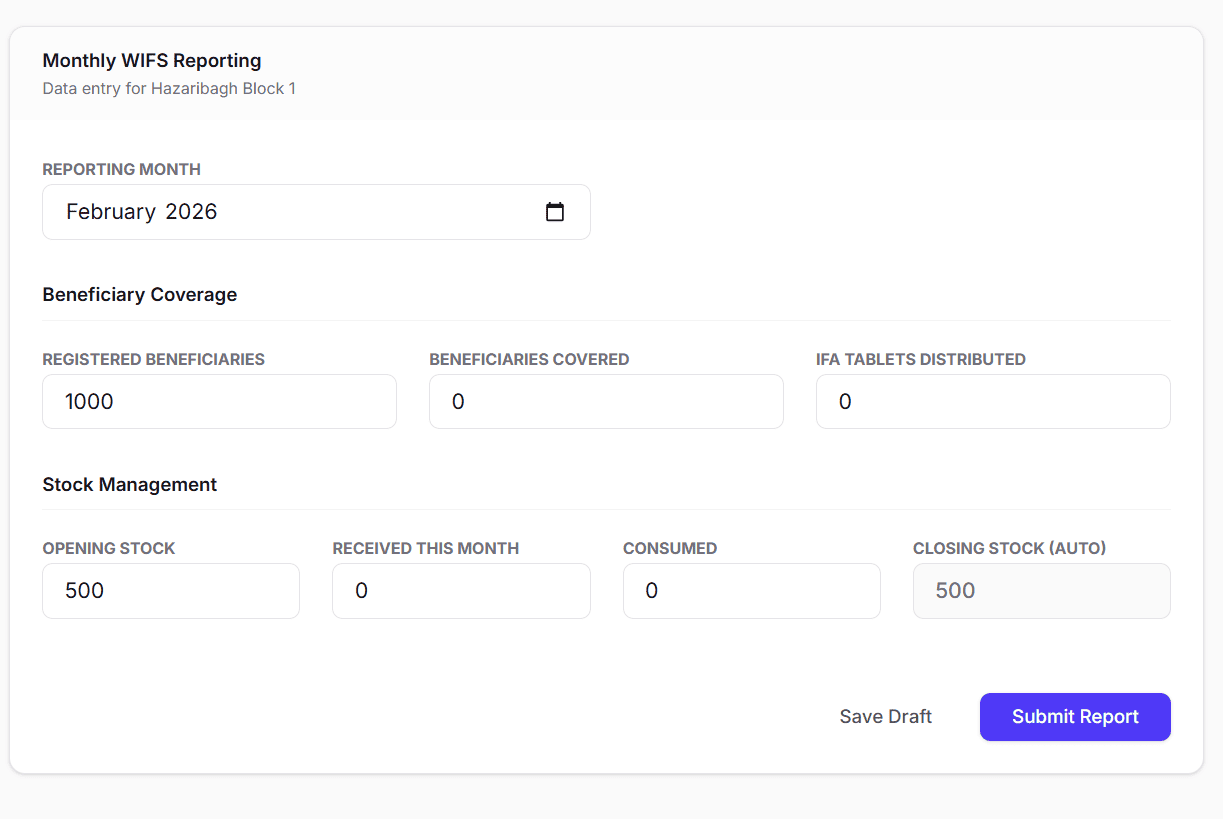
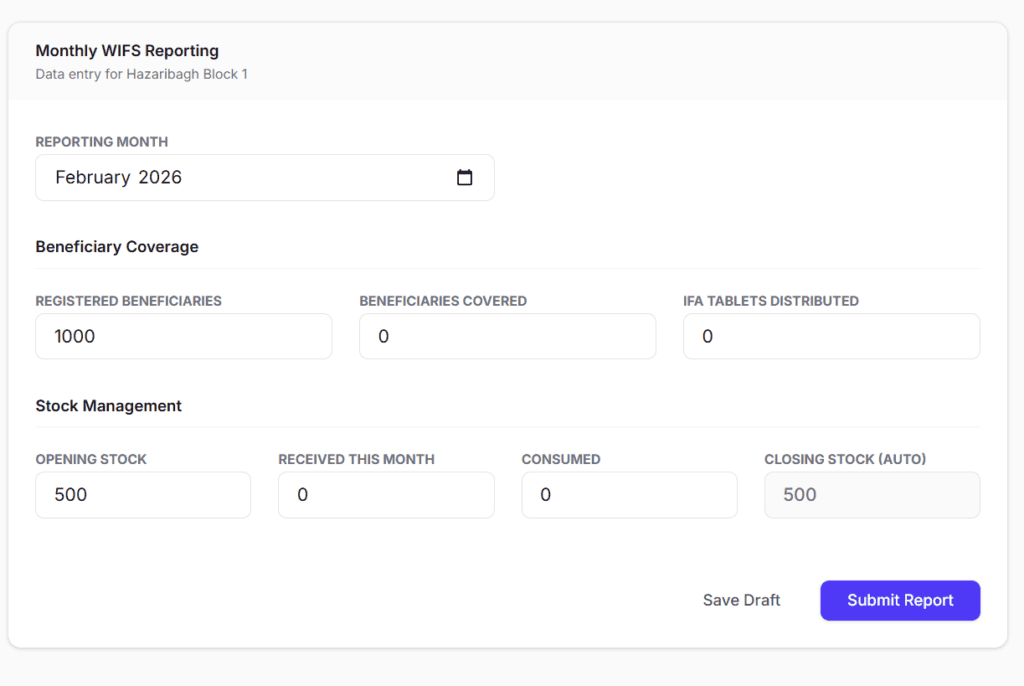
Block-level Data Entry Module:
– Intuitive Data Entry Forms: Simplified web-based forms for block health functionaries to enter monthly WIFS data including beneficiary coverage, IFA distribution, deworming coverage, and adverse event reporting
- Built-in Validation: Field-level validation rules preventing common data entry errors such as coverage exceeding registered beneficiaries, negative stock values, and missing mandatory fields
- Auto-save Functionality: Automatic saving of partially completed forms to prevent data loss
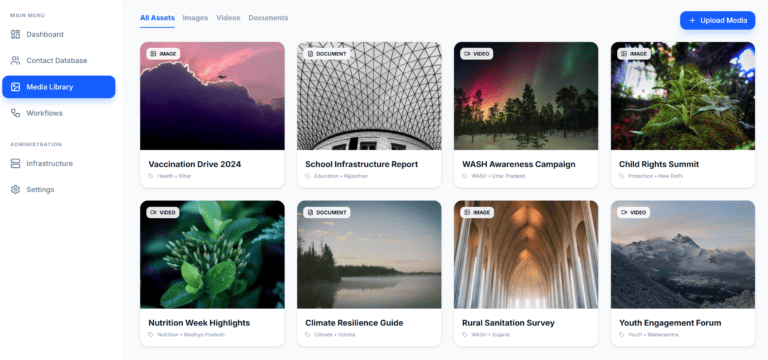
- Reference Data Management: Pre-populated dropdown menus for blocks, schools, and Anganwadi centers to minimize manual entry
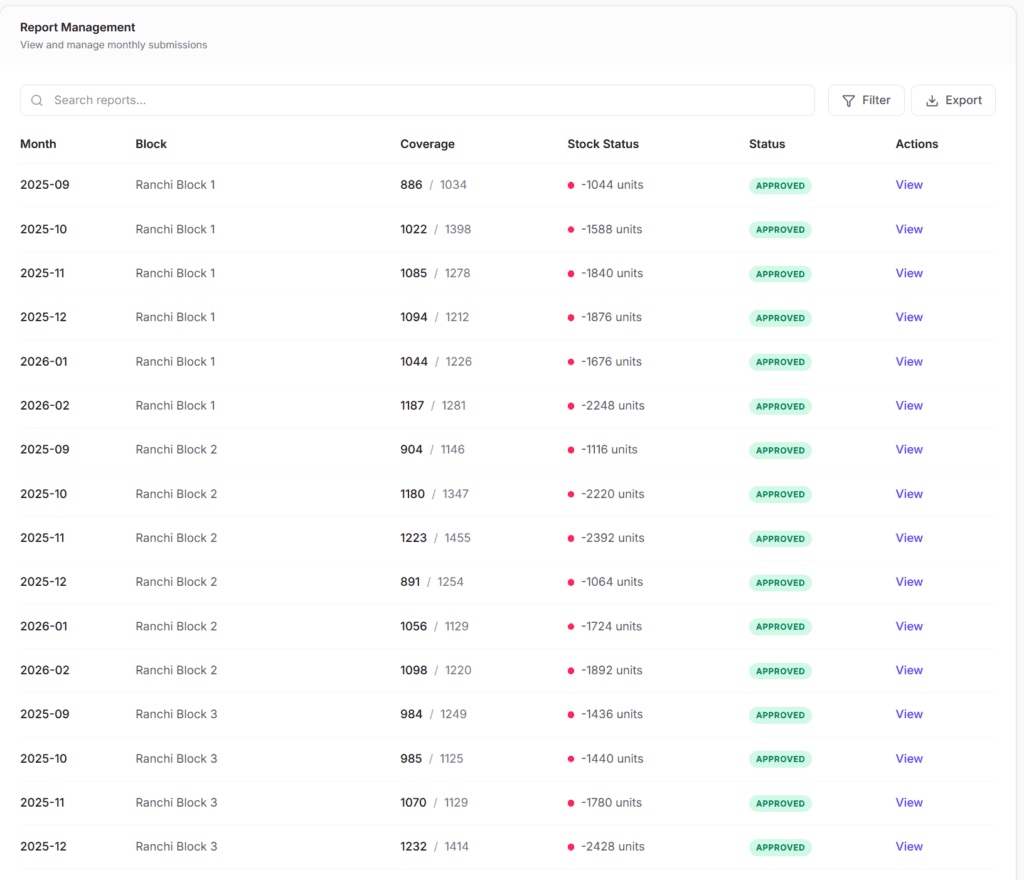
District-level Validation & Approval:
– Review Dashboard: District health officers could review block submissions, flag discrepancies, and request corrections before approving data
– Comparison Analytics: Side-by-side comparison of current month data with previous months to identify anomalies
– Approval Workflow: Formal approval mechanism with digital sign-off, creating an audit trail of validated data
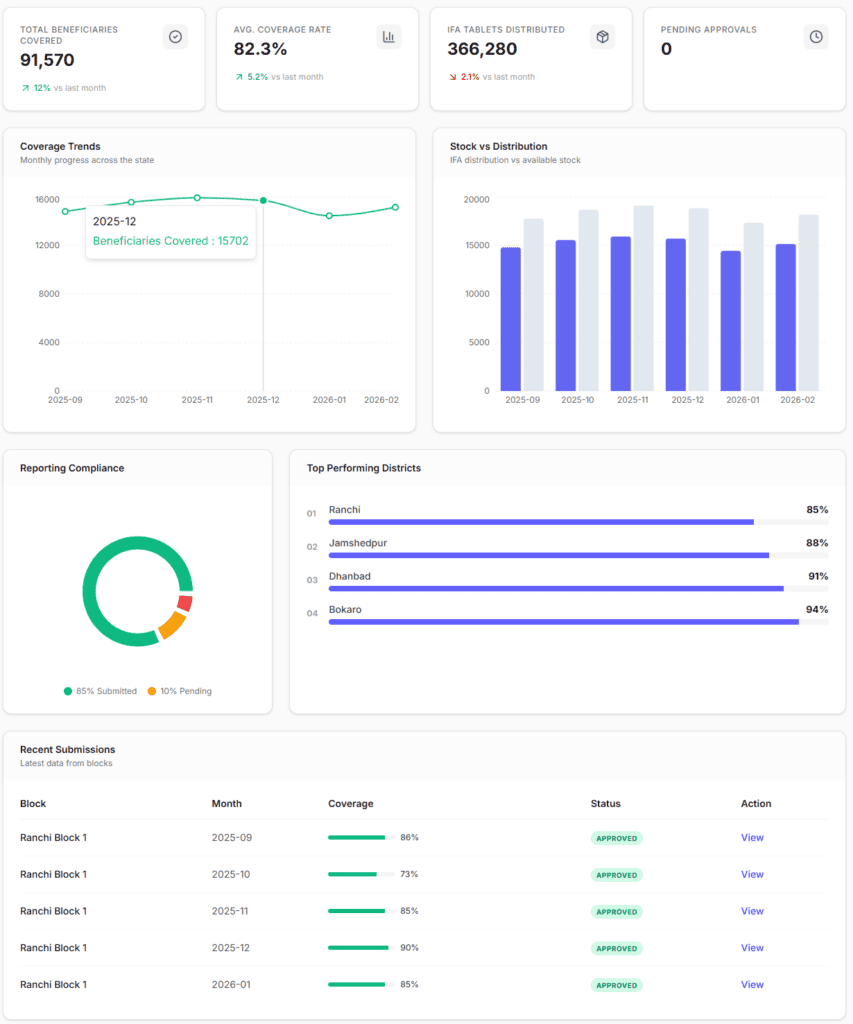
State-level Dashboard & Analytics:
– Coverage Dashboard: Visual dashboard showing WIFS programme coverage (IFA distribution, consumption, deworming) across all districts and blocks
– Stock Position Monitoring: Real-time view of IFA tablet stock levels at block and district levels with threshold-based color coding (green/amber/red)
– Trend Analysis: Month-over-month trend charts for key programme indicators
- Comparative Reports: District and block rankings based on programme performance metrics
Alert & Notification System:
– SMS Alerts: Automated SMS notifications to block and district functionaries for approaching reporting deadlines, overdue submissions, and critical stock levels
– Email Notifications: Periodic email digests to district and state officials summarizing programme status
- Escalation Mechanism: Automated escalation of non-reporting blocks to district and state levels
Reporting & Export:
– Standard Reports: Pre-configured monthly, quarterly, and annual reports aligned with national WIFS reporting formats
– Custom Reports: Flexible report builder for ad-hoc analysis
– Export Capabilities: Data export in Excel and PDF formats for offline analysis and presentations
Technology Stack
- Frontend: HTML5, CSS3, JavaScript, jQuery
- Backend: PHP / ASP.NET
- Database: MySQL / MS SQL Server
- SMS Gateway: Integration with SMS service provider for automated alerts
- Email: SMTP integration for notification emails
- Hosting: Government server infrastructure (NIC/State Data Center)
Implementation Approach
Velocity executed a rapid 3-month implementation:
Requirements Finalization (Week 1-2): Workshops with UNICEF, State Health Department, and district health officials to finalize data fields, validation rules, approval workflows, and alert thresholds. Reviewed national WIFS programme guidelines and reporting formats.
Development (Week 3-8): Built the block-level data entry module with validation rules. Developed the district approval workflow and state-level dashboard. Integrated SMS and email notification services. Created the stock position monitoring module with threshold-based alerts.
Testing & Pilot (Week 8-10): Conducted testing with sample data from select blocks. Pilot deployment in 2-3 districts with real users. Collected feedback on usability, data flow, and alert effectiveness. Iterative refinements.
Deployment & Training (Week 10-12): Deployed on government server infrastructure. Conducted training sessions for block-level data entry operators, district validators, and state-level administrators. Distributed user manuals in Hindi.
Go-live Support (Week 12-13): Monitored initial data entry cycles, provided real-time support, and addressed issues. Ensured all blocks were successfully onboarded.
Key Outcomes & Impact
- Digitized WIFS Monitoring: Replaced paper-based reporting with a structured online MIS, enabling real-time visibility into programme implementation across Jharkhand
- Improved Data Quality: Built-in validation rules and district-level approval workflow significantly reduced data entry errors and improved reporting accuracy
- Real-time Stock Visibility: Stock position monitoring enabled proactive redistribution of IFA tablets, reducing both stockouts and wastage due to expiry
- Timely Reporting: SMS and email alerts improved reporting compliance, with block-level submission rates increasing substantially after system deployment
- Evidence-based Decision Making: State and district health officials gained access to timely, validated programme data for planning and resource allocation
- Scalable Platform: The system architecture supported the addition of new health programme modules beyond WIFS
- Capacity Building: Training sessions empowered block-level functionaries to use digital tools for programme monitoring
Why Velocity?
Velocity Software Solutions was selected for this health MIS project based on our:
- Expertise in government health information systems with experience across multiple states and national programmes
- Strong understanding of India’s public health programme architecture including block-district-state data flows and approval hierarchies
- Proven ability to build user-friendly interfaces accessible to users with limited technical skills in government settings
- Experience with SMS and alert integration for automated compliance monitoring
- Track record of deploying on government infrastructure (NIC/State Data Centers) with appropriate security and compliance standards
- Rapid delivery capabilities demonstrated by consistent on-time completion of projects under tight timelines
Velocity Software Solutions partners with UNICEF and government health departments to build digital systems that strengthen public health programme monitoring, ensuring that life-saving interventions reach every adolescent across India.