Native or Flutter App Development: What to Choose in 2026
Download MarkDown
Native development has been the standard for creating mobile apps since the inception of smartphones. Developers have traditionally used platform-specific languages — Java or Kotlin for Android and Objective-C or Swift for iOS to build apps that work seamlessly on their respective platforms.
However, with the introduction of Google’s Flutter framework, developers now have another powerful option for creating high-quality mobile apps. Flutter allows developers to build both Android and iOS applications using a single codebase, significantly reducing development time and effort.
Still, choosing between Native and Flutter remains a hot topic in mobile app development. While Flutter enables faster project completion, native development provides deeper flexibility and customization options.
Let’s explore the technical differences between Native and Flutter development.
Native Development
Native development involves building mobile applications using platform-specific languages and tools provided by the operating system:
- iOS: Objective-C or Swift
- Android: Java or Kotlin
Advantages of Native Development:
- Complete control over performance, look, and feel
- Direct access to all native APIs and device features
- Optimized speed and responsiveness
- Better performance for complex applications
- Seamless integration with hardware features (camera, GPS, push notifications, etc.)
Drawbacks:
- Separate codebases required for Android and iOS
- Higher development cost
- Longer development time
- Requires expertise in multiple programming languages
Flutter Development
Flutter is a mobile app development framework introduced by Google in 2017. It uses the Dart programming language and provides a rich set of customizable widgets for building visually attractive applications.
Advantages of Flutter:
- Single codebase for Android and iOS
- Faster development cycle
- Hot reload feature for real-time updates
- Beautiful, customizable UI components
- Easy integration with other tools and frameworks
- Ideal for startups and MVP development
Drawbacks:
- Limited direct access to some native APIs
- May require third-party libraries
- Performance may not match fully optimized native apps in complex scenarios
- Learning curve for Dart (if unfamiliar)
Key Differences Between Native and Flutter Development
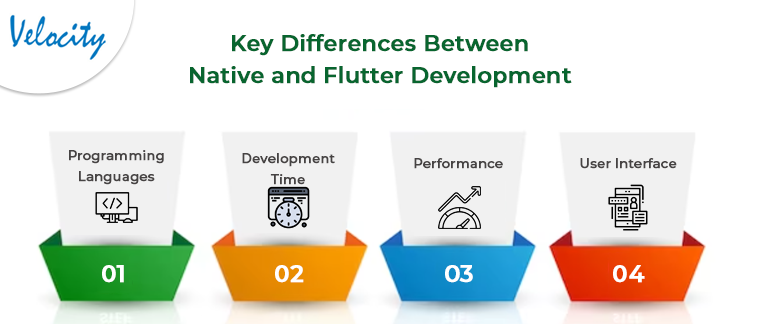
1. Programming Languages
- Native: Java, Kotlin, Swift, Objective-C
- Flutter: Dart
Dart is similar to Java and C++, but developers may need time to adapt if unfamiliar.
2. Development Time
- Native development requires separate codebases for each platform.
- Flutter uses a single codebase, significantly reducing development time.
Both Native and Flutter apps are developed using tools like Android Studio and Xcode.
3. Performance
Native apps generally offer better performance because they are optimized for their respective platforms and have full access to native APIs.
Flutter performs well for most applications but may not match native performance in highly complex or resource-intensive apps.
4. User Interface

- Native apps strictly follow platform-specific design guidelines (Material Design for Android, Human Interface Guidelines for iOS).
- Flutter provides a rich collection of customizable widgets that make UI development faster and consistent across platforms.
What to Choose in 2023?
The decision between Native and Flutter app development depends on your project requirements:
Choose Native Development if:
- Performance is your top priority
- You need deep hardware integration
- You are building a highly complex app
- Budget and time are less restrictive
Choose Flutter if:
- You want faster time-to-market
- You need a cost-effective solution
- You are building an MVP or startup product
- Cross-platform consistency is important
Both approaches have their strengths. The right choice depends on your business goals, technical requirements, timeline, and budget.
Conclusion
In 2023, both Native and Flutter app development remain strong contenders in the mobile development landscape. Native ensures maximum performance and platform-specific optimization, while Flutter provides efficiency, speed, and cross-platform convenience.
If you’re unsure which approach suits your project best, the team at Velsof, with 10+ years of experience in Native and Flutter app development, would be happy to assist you.
For any queries, feel free to contact us at [email protected].