Case Study: Performance Rating & Review System (PRRS) Upgrade
Download MarkDownThe Challenge
UNICEF India had been using a Performance Rating and Review System built on a 3-point rating scale. Following updates to UNICEF’s global HR policies and best practices in performance management, the organization needed to upgrade the system to a more granular 5-point rating scale. The key challenges included:
- Rating Scale Migration: Transitioning from a 3-point to a 5-point rating system without disrupting the ongoing performance cycle or losing historical data
- Configurable Architecture: The new system needed to be flexible enough for administrators to modify rating scales, descriptors, and weightages without requiring code changes
- Multi-tenancy Requirements: The platform served multiple UNICEF offices and divisions, each with potentially different review workflows and approval hierarchies
- Workflow Continuity: In-progress reviews needed to be gracefully handled during the migration, with clear transition rules
- Data Integrity: Historical performance data under the old 3-point scale needed to be preserved and remain accessible alongside the new 5-point data
- User Adoption: Minimizing disruption for managers and staff already familiar with the existing interface and workflow
Velocity’s Solution
Scope of Work
Velocity Software Solutions executed the comprehensive upgrade of the PRRS platform, encompassing:
- System analysis and impact assessment of the rating scale change
- Database schema modifications to support configurable rating scales
- Admin panel development for dynamic rating configuration
- UI/UX redesign for the new 5-point rating interface
- Migration of historical data with backward compatibility
- Multi-tenancy enhancements
- Testing, deployment, and post-deployment support
Key Features & Deliverables
Configurable Rating Engine:
– Dynamic Rating Scales: Admin-configurable rating scales allowing the organization to define the number of ratings, labels, descriptions, numeric values, and color codes without code deployment
- Weighted Competencies: Configurable weightage assignment for different performance competencies and objectives
- Rating Descriptors: Detailed behavioral descriptors for each rating level to ensure consistent evaluation standards
- Scale Transition Logic: Intelligent mapping rules for transitioning from the 3-point to 5-point scale in historical context
Enhanced Admin Panel:
– Rating Configuration Dashboard: Intuitive interface for HR administrators to create, modify, and manage rating scales
– Review Cycle Management: Tools for defining review periods, deadlines, and escalation rules
– Organization Hierarchy Management: Configurable reporting structures and approval chains
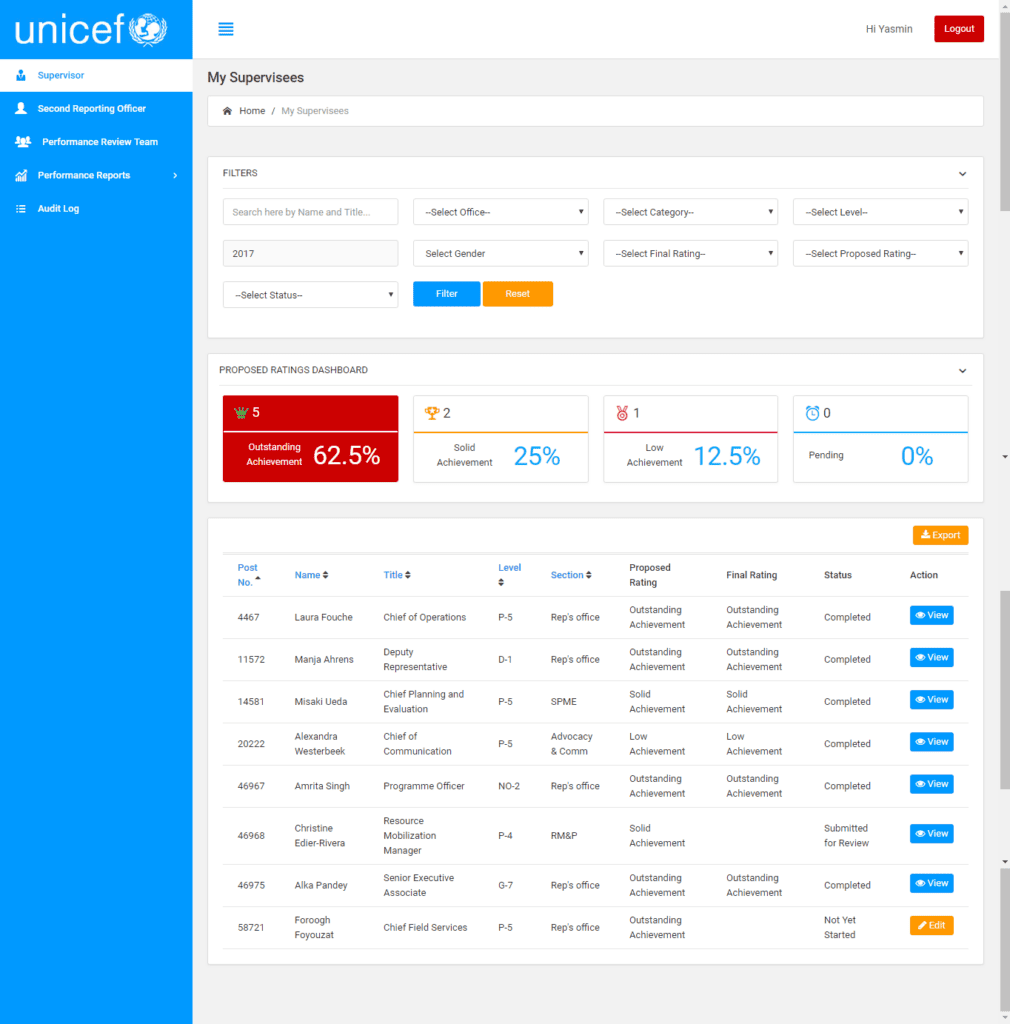
- Bulk Operations: Mass assignment, notification, and status update capabilities for large-scale review cycles
- Audit Trail: Complete logging of all administrative changes for compliance and governance
Multi-tenancy Enhancements:
– Office-level Configuration: Support for different review configurations per UNICEF office or division
- Shared Infrastructure: Single deployment serving multiple organizational units with data isolation
- Role-based Access: Granular permissions ensuring users only access data within their organizational scope
- Centralized Reporting: Cross-office analytics and reporting for Country Office leadership
User Interface Improvements:
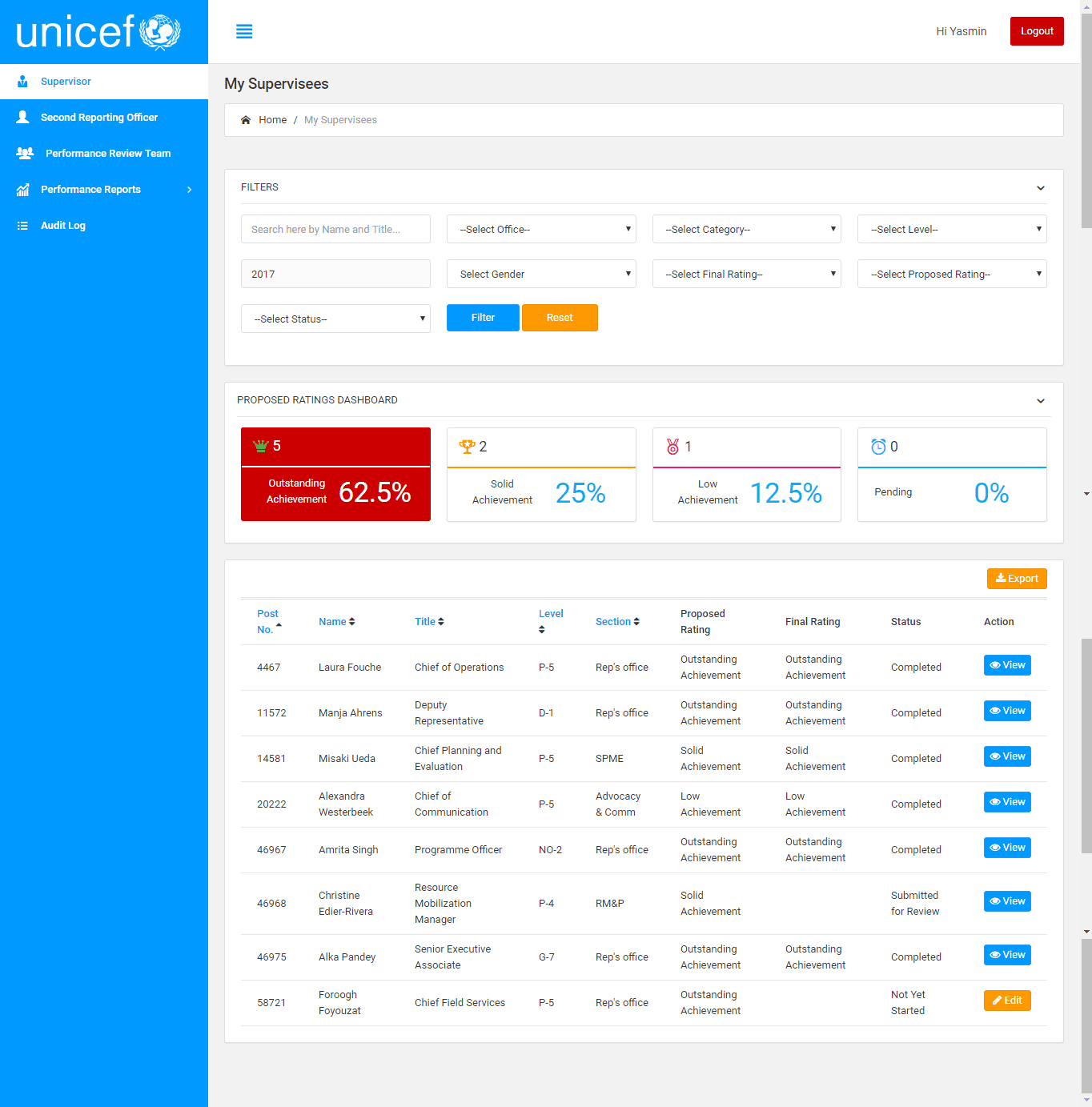
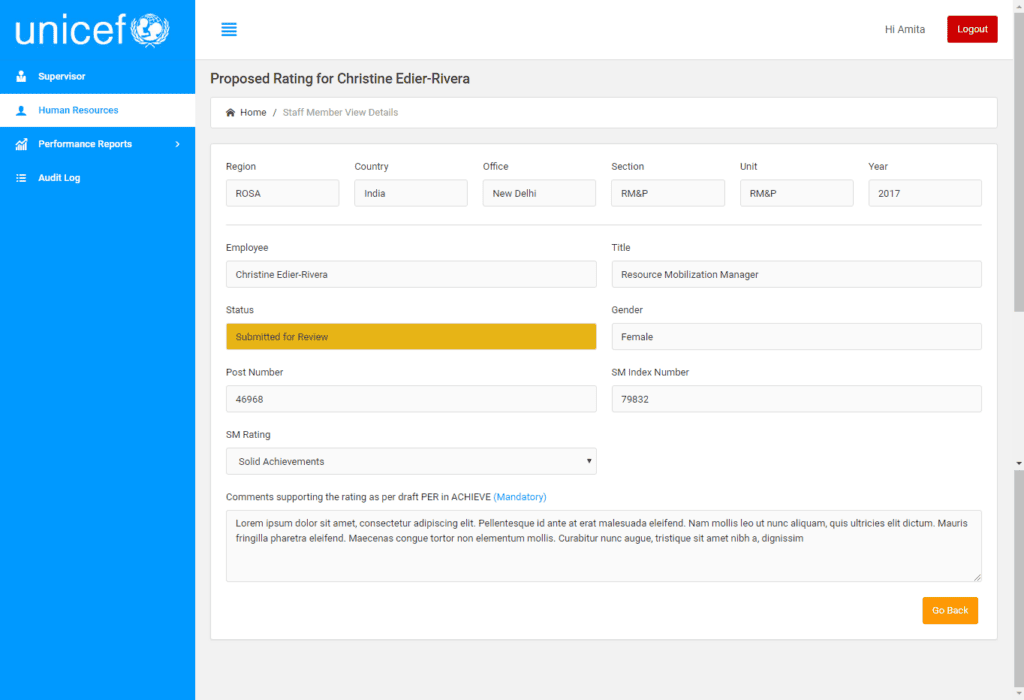
– Redesigned Review Form: Updated interface accommodating the 5-point scale with clear visual indicators and tooltips
– Progress Tracking: Dashboard showing review completion status across teams and offices
– Notification System: Email and in-app notifications for review deadlines, approvals, and actions required
– Historical View: Ability to view past reviews under both the 3-point and 5-point scales with contextual indicators
Technology Stack
- Backend: ASP.NET / .NET Framework
- Database: Microsoft SQL Server
- Frontend: HTML5, CSS3, JavaScript, jQuery
- Authentication: Active Directory / LDAP integration
- Hosting: UNICEF internal server infrastructure
- Reporting: SQL Server Reporting Services (SSRS)
Implementation Approach
Velocity followed a structured upgrade methodology designed to minimize disruption to ongoing operations:
Impact Assessment (Month 1): Comprehensive analysis of the existing PRRS codebase, database schema, and business logic. Identified all components affected by the rating scale change. Documented the current state and defined the target architecture.
Design & Architecture (Month 1-2): Designed the configurable rating engine, database schema modifications, and admin panel wireframes. Conducted review sessions with UNICEF HR and IT teams for sign-off. Defined data migration strategy for historical records.
Core Development (Month 2-4): Built the configurable rating engine and admin panel. Modified the review workflow to support 5-point ratings. Developed the data migration scripts with rollback capabilities. Enhanced multi-tenancy features.
Integration & Testing (Month 4-5): Comprehensive testing including unit tests, integraion tests, and user acceptance testing (UAT) with UNICEF HR stakeholders. Performance testing under multi-tenant load conditions. Regression testing to ensure no impact on existing functionality.
Deployment & Migration (Month 5-6): Executed the production deployment during a planned maintenance window. Ran data migration scripts with verification checks at each stage. Configured the new 5-point rating scale through the admin panel. Conducted administrator and user training sessions.
Post-deployment Support (Month 6): Monitored system performance and user adoption. Addressed post-deployment issues and user feedback. Provided documentation and knowledge transfer.
Key Outcomes & Impact
- Seamless Migration: Successfully transitioned from 3-point to 5-point rating scale with zero data loss and no disruption to the ongoing performance cycle
- Administrator Empowerment: The configurable admin panel enabled UNICEF HR teams to manage rating scales, review cycles, and organizational structures independently, reducing dependence on technical teams
- Improved Performance Differentiation: The more granular 5-point scale enabled better differentiation of employee performance, leading to more meaningful feedback and development planning
- Multi-office Support: Enhanced multi-tenancy features enabled consistent yet customizable performance management across UNICEF India’s offices and divisions
- Audit Compliance: Comprehensive audit trail and reporting capabilities ensured transparency and accountability in the performance review process
- Historical Continuity: Staff and managers could access complete performance history spanning both rating scales, maintaining continuity in career development tracking
- Future-proof Architecture: The configurable design ensures UNICEF can adapt the system to future policy changes without additional development
Why Velocity?
Velocity Software Solutions was chosen to upgrade this mission-critical HR system based on our:
- Extensive experience with .NET enterprise applications and Microsoft SQL Server platforms
- Deep understanding of UN agency internal systems and their governance, compliance, and security requirements
- Proven methodology for legacy system upgrades that minimize disruption while delivering modern, configurable architectures
- Track record of delivering on time for UNICEF India across multiple projects
- Strong competency in multi-tenant application design supporting diverse organizational structures
- Commitment to knowledge transfer ensuring UNICEF teams can independently manage and evolve the system
Velocity Software Solutions brings deep expertise in enterprise application modernization, helping organizations like UNICEF upgrade mission-critical systems while preserving data integrity and ensuring business continuity.