
TrexoGlobal – DocGen Platform (Metis) Case Study
Download MarkDownThe Challenge
TrexoGlobal is a technology company focused on building smart workflow solutions powered by AI and ML for the intellectual property (IP) management lifecycle. Their flagship initiative, the Metis platform, serves as the launching platform for individual applications built around specific stages in the IP management lifecycle.
IP paralegals face a significant operational burden in their daily work: during the lifecycle of a Patent or Trademark, applicants must correspond with Patent and Trademark Offices (PTOs) using multiple prescribed forms and customized documents. Considering that a single paralegal may be responsible for hundreds of applications simultaneously, the manual process of form preparation, data entry, and filing at the USPTO (United States Patent and Trademark Office) is extremely time-consuming and error-prone.
The specific challenges TrexoGlobal sought to address included:
- Manual Form Generation: IP paralegals spent excessive time manually populating USPTO forms with patent metadata, leading to errors and inefficiency
- Fragmented Workflow: The process of generating forms, obtaining signatures, and filing at the USPTO was disconnected, requiring paralegals to switch between multiple systems and manual processes
- Data Management Complexity: Patent metadata received from third-party IP Management Systems (IPMS) needed to be cleaned, stored, and managed across multiple matters and tenants
- Limited Template Management: There was no centralized system for maintaining, customizing, and categorizing the 100+ USPTO form templates used across different patent types, countries, and categories
- Manual USPTO Filing: Filing documents at the USPTO Patent Centre was a separate, manual process disconnected from the form generation workflow
- No E-Signature Integration: Documents requiring signatures had to be managed outside the system, adding delays and complexity
- Scalability Constraints: The solution needed to support a multi-tenant architecture where multiple organizations could operate independently on the same platform
Velocity’s Solution
Scope of Work
Velocity developed DocGen — a comprehensive document generation, management, and filing module within the Metis platform. The solution automated the entire workflow from receiving patent metadata, through form generation and customization, to direct filing at the USPTO Patent Centre, dramatically simplifying the life of IP paralegals.
Key Features & Deliverables
Three Major Workflow Modules
1. Generate (Core Module)
– Pre-configured USPTO templates (up to 100 as MVP) ranging from 1-10 pages
– Automated metadata population on forms from associated patent matters
– Matter selection with search functionality
– Form selection with conditional routing based on matter existence in the database
– Record Entry Form for new matter creation
– Automated metadata retrieval and population on selected forms
– PDF preview with zoom-in/zoom-out capabilities
– In-form modification and data editing capabilities
– Single and bulk processing options
– Document management (copy, send, assign, download, upload, delete, replace)
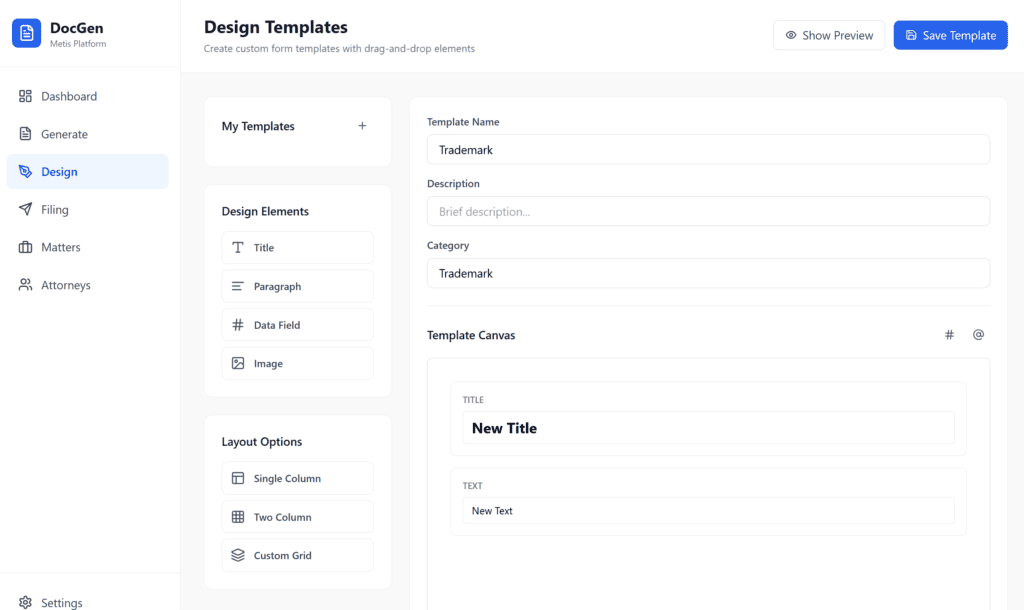
2. Design (Template Builder)
– Intuitive form design widgets for building custom templates from scratch
– Layout selection options for different document types
– Element-by-element customization (title, logo, header, footer, paragraph, address, email, etc.)
– Metadata field insertion capability (via # and @ buttons)
– Configurable components meeting all custom requirements
– PDF/DOCX generation from designed templates
– Template storage, sharing, and assignment capabilities
3. Filing (USPTO Integration)
– Direct integration with USPTO Patent Centre
– Document selection from within DocGen or external import
– Application number and confirmation number entry
– Attorney selection and management
– Drag-and-drop document upload to USPTO
– Automatic document type identification and description mapping
– Document splitting and indexing capabilities
– Fee calculation and fee code selection
– Review and submit workflow with real-time status updates
DocGen Home Page and Navigation
– My Forms: Central folder listing all generated, designed, shared, received, signed, and filed forms
– Drafts: Storage for forms saved as drafts during Generate, Design, or Filing tasks
– Favorites: Quick-access storage for frequently used templates
– Deleted items management
– Search, filter, and sort capabilities across all views
Data Management
– Third-party data receiving via CSV/XLSX file drag-and-drop
– Data cleansing before database insertion
– Multi-tenant data management architecture
– Data purge capabilities
– Duplicate data identification
– Record-level data management with comprehensive metadata fields
Automation Engine
– Automation 1: Automatic metadata population on forms when matter and form are paired
– Automation 2: Automatic record creation and document storage for imported forms
– Automation 3: Real-time status update in records upon USPTO filing completion
E-Signature Workflow
– Document sending for signature via email (attachment or link)
– Integration with third-party tools (DocuSign, Adobe Sign)
– Signed document receipt and status tracking
– Document storage with “Signed” status in database
Integration and Document Management
– USPTO Patent Centre integration for direct filing
– Open architecture for integration with DocuSign, iManage, netDocuments
– Share via email with message feature
– Share via link functionality
Technology Stack
- Architecture: Multi-tenant with single database and single application deployment
- Cloud Infrastructure: AWS (Code Pipeline, Code Build, Code Deploy, S3 Bucket)
- Version Control: GitHub with CI/CD pipeline
- Frontend: Modern web framework with intuitive UI/UX
- Backend: Scalable server-side architecture
- Database: Multi-tenant relational database
- PDF Engine: PDF viewer and editor with e-signature workflow
- Integration: USPTO Patent Centre API, DocuSign/Adobe Sign, iManage/netDocuments
- Development Methodology: Agile (JIRA and Confluence for documentation)
Implementation Approach
Velocity followed the Agile development methodology with comprehensive documentation on JIRA and Confluence:
Phase 1 – Requirements Analysis and Architecture
– Deep analysis of existing IP paralegal workflows and pain points
– Understanding of USPTO filing processes and requirements
– Definition of multi-tenant architecture requirements
– System architecture documentation (high-level and low-level)
– Technology stack finalization in consultation with TrexoGlobal
Phase 2 – Core Platform Development (Generate Module)
– Database schema design for multi-tenant matter management
– Third-party data receiving and cleansing pipeline
– Record Entry Form development for manual matter creation
– Template repository setup with 100 MVP forms
– Automated metadata population engine
– PDF viewer/editor with modification capabilities
– Preview and bulk processing features
Phase 3 – Design Module Development
– Form design widget library creation
– Layout template options
– Element-by-element customization engine
– Metadata field insertion system
– PDF/DOCX generation from custom designs
Phase 4 – Filing Module and USPTO Integration
– USPTO Patent Centre integration development
– Document upload and management workflow
– Fee calculation engine
– Attorney management system
– Status tracking and update automation
Phase 5 – Integration and Automation
– E-signature workflow integration (DocuSign)
– Email and sharing capabilities
– Three core automation engines
– Document management system integration
Phase 6 – Testing and Deployment
– Comprehensive functional testing
– Multi-tenant testing scenarios
– USPTO integration testing
– Performance and security testing
– User acceptance testing
– Production deployment via AWS CI/CD pipeline
Key Outcomes & Impact
- Dramatic Efficiency Gains: IP paralegals could generate forms in minutes instead of hours, with automatic metadata population eliminating manual data entry across hundreds of patent matters
- End-to-End Workflow Automation: The seamless flow from data receipt through form generation, signature, and USPTO filing eliminated the need to switch between multiple disconnected systems
- Error Reduction: Automated metadata population and validation significantly reduced human errors in patent filing documents, mitigating costly legal risks
- Scalable Multi-Tenant Platform: The architecture supported multiple organizations operating independently, enabling TrexoGlobal to serve a growing customer base
- Custom Template Capability: The Design module empowered paralegals to create and customize their own templates, accommodating unique organizational requirements without developer involvement
- Real-Time Status Tracking: Automated status updates upon USPTO filing provided paralegals with instant visibility into document submission status
- Comprehensive Document Management: Centralized storage, search, and management of all generated, signed, and filed documents created a complete audit trail
Why Velocity
Velocity was selected as the technology partner for DocGen based on:
- Complex Workflow Automation Expertise: Proven experience building sophisticated multi-step workflow applications with conditional routing, automation engines, and third-party integrations
- Enterprise Architecture Skills: Capability to design and implement multi-tenant, scalable architectures using AWS cloud infrastructure with CI/CD pipelines
- PDF and Document Processing: Deep expertise in PDF generation, viewing, editing, and e-signature integration — core technical requirements for DocGen
- Agile Development Maturity: Established Agile practices with JIRA and Confluence documentation, enabling iterative development with continuous client feedback
- Integration Capabilities: Experience integrating with third-party systems and APIs, critical for USPTO Patent Centre integration, e-signature services, and document management platforms
- Full-Stack Team: Comprehensive team covering system architecture, frontend development, backend engineering, database design, DevOps, and quality assurance
- Long-Term Partnership Orientation: Commitment to ongoing support, maintenance, and feature development as the Metis platform evolves