Case Study: Student Access to Distance Learning – COVID-19 Monitoring System
Download MarkDownThe Challenge
The sudden shift to remote learning during COVID-19 exposed significant digital divides and access inequities across India. The challenges in building a monitoring system were unprecedented:
- Urgent Timeline: The pandemic created an emergency need for a monitoring platform to be developed and deployed rapidly while schools remained closed and distance learning efforts were underway
- National Scale with Heterogeneous Data: India’s education system spans 1.1 million schools (in the U-DISE database) across 36 states and union territories, each with different distance learning strategies and infrastructure
- Multiple Learning Modalities: Students were accessing learning through diverse channels — Doordarshan and state TV channels, All India Radio, DIKSHA (national digital learning platform), WhatsApp groups, printed worksheets — requiring the monitoring system to capture engagement across all modalities
- Connectivity Challenges: Many of the communities most at risk of learning loss were in areas with limited internet connectivity, requiring the data collection app to work offline
- U-DISE Database Integration: The system needed to integrate with India’s Unified District Information System for Education (U-DISE) database containing data on 1.1 million schools for school identification, geocoding, and categorization
- Bilingual Requirement: The platform needed to function in both English and Hindi to serve education administrators and field monitors across the country
- Field Data Collection: The system required an Android mobile app for field monitors to visit schools and communities, collecting ground-level data on student access patterns
- Open Source Mandate: The solution needed to be built on open-source technologies with no proprietary dependencies
Velocity’s Solution
Scope of Work
Velocity Software Solutions designed, developed, and deployed an end-to-end Student Access to Distance Learning Monitoring System, comprising:
- Android mobile application for field-level data collection
- Web-based administrative dashboard for monitoring and analytics
- Integration with U-DISE national school database (1.1 million schools)
- Offline-capable architecture for low-connectivity environments
- Bilingual (English/Hindi) interface
- Open-source technology stack
Key Features & Deliverables
Android Mobile Application:
– Structured Survey Forms: Mobile-optimized survey forms capturing data on student access to distance learning across multiple modalities:
– Television-based learning (Doordarshan, state channels)
– Radio-based learning (All India Radio, community radio)
– Online/digital learning (DIKSHA, state platforms, WhatsApp)
– Printed material distribution
– Community-based learning interventions
- Offline-first Architecture: Complete offline functionality allowing field monitors to collect data in areas without internet, with automatic synchronization when connectivity is restored
- GPS-tagged Data Collection: Automatic GPS capture at the point of data collection for geographic verification and mapping
- School Identification via U-DISE: Integration with the U-DISE database allowing monitors to search and select schools by name, code, district, or block, eliminating manual entry errors
-
Photo Documentation: Capability to capture and upload photographs of learning activities, community engagement, and infrastructure
-
Hindi Language Interface: Complete Hindi localization of the mobile app for monitors working in Hindi-speaking states
- Low Bandwidth Optimization: Compressed data transmission and queued uploads designed for 2G/3G networks
- Progress Tracking: In-app tracking of assigned schools/communities visited vs. pending
Web-based Administrative Dashboard:
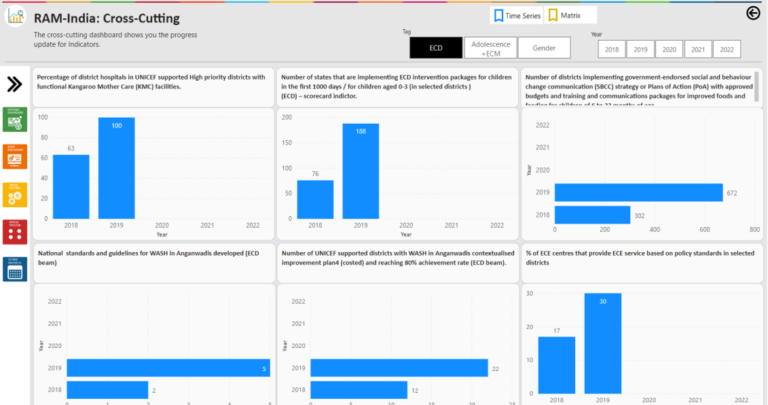
– National Overview: Interactive India map showing district-wise coverage of distance learning monitoring, with color-coded indicators for access levels
- Multi-level Drill-down: National to state to district to block to school-level navigation, with contextually relevant metrics at each level
- Distance Learning Access Analytics:
- Percentage of students accessing TV-based learning by state/district
- Percentage accessing digital/online platforms
- Percentage receiving printed materials
- Percentage with no access to any learning modality (most at-risk)
- Disaggregation by gender, urban/rural, school type, and social category
- Trend Monitoring: Time-series tracking of access patterns over weeks and months of the pandemic response
-
Gap Identification: Automated identification of geographic areas and demographic groups with lowest access rates, enabling targeted intervention
-
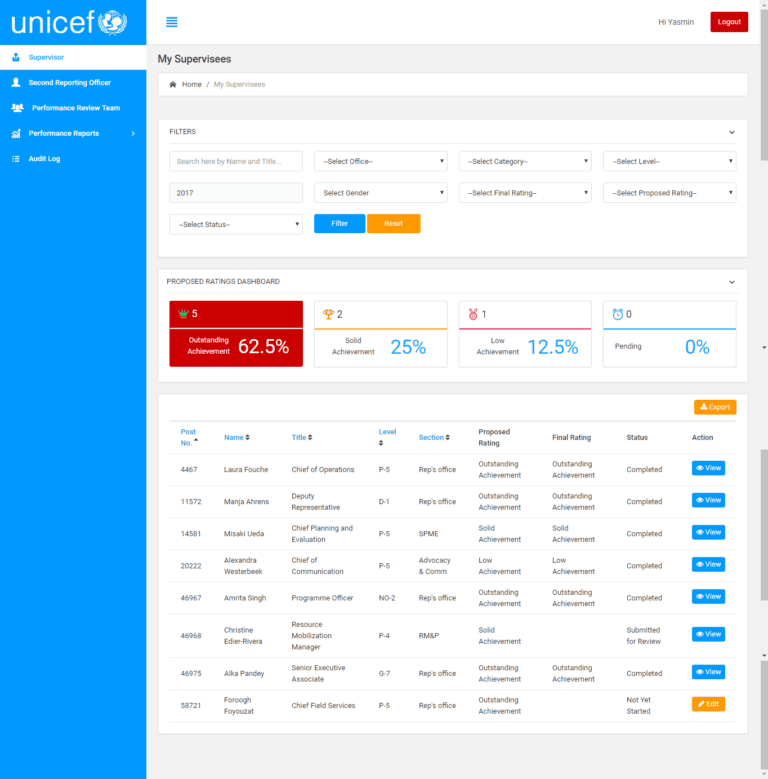
Field Monitor Management: Dashboard for tracking monitor deployment, data collection progress, and coverage
- Data Quality Monitoring: Automated flagging of incomplete submissions, outlier values, and GPS-coordinate mismatches
U-DISE Database Integration:
– 1.1 Million School Records: Integration with the national U-DISE database for school master data including school name, code, location, type, management, enrollment, and infrastructure details
– Geographic Mapping: U-DISE-based geocoding enabling accurate school location mapping on dashboards
- School Categorization: Automatic categorization by school type (primary, upper primary, secondary), management (government, aided, private), and location (urban, rural, tribal)
- Enrollment Baseline: U-DISE enrollment data serving as the denominator for calculating access percentages and coverage rates
Reporting & Export:
– Automated Reports: Pre-configured weekly and monthly reports on distance learning access patterns by state and district
– Custom Analytics: Flexible report builder for ad-hoc analysis by geography, school type, learning modality, and demographic disaggregation
– Data Export: Complete data export in Excel, CSV, and PDF formats for offline analysis and presentations
– API Access: Programmatic access to monitoring data for integration with other UNICEF and government reporting systems
Technology Stack
- Mobile App: Android (Java/Kotlin) with SQLite for offline storage
- Backend: Open-source server-side framework (Python/Django or Node.js)
- Database: PostgreSQL / MySQL
- Frontend Dashboard: HTML5, CSS3, JavaScript with open-source visualization libraries
- Mapping: Leaflet / OpenStreetMap for geographic visualizations
- APIs: RESTful APIs for mobile-backend communication and U-DISE integration
- Hosting: Cloud-based infrastructure
- Security: SSL/TLS, OWASP compliance, data encryption, role-based access
Implementation Approach
Given the emergency nature of the COVID-19 response, Velocity adopted a rapid, iterative development approach:
-
Rapid Requirements & Design (Month 1): Emergency consultation with UNICEF programme teams and Ministry of Education to define priority monitoring indicators. Rapid prototyping of the mobile app and dashboard wireframes. U-DISE database assessment and integration strategy.
-
MVP Development (Months 1-3): Built the core Android app with offline data collection and GPS tagging. Developed the web dashboard with national map view and basic analytics. Integrated U-DISE school database for school identification. Deployed to initial 18,000-20,000 schools for first wave of monitoring.
-
Scale-up & Enhancement (Months 3-5): Enhanced the dashboard with advanced analytics, trend monitoring, and gap identification. Built the Hindi language interface for the mobile app. Optimized offline sync and low-bandwidth performance. Expanded coverage based on initial deployment learnings.
-
National Scale Integration (Months 5-7): Full integration with U-DISE’s 1.1 million school records. Performance optimization for national-scale data volumes. Additional reporting templates for Ministry of Education reporting requirements. API development for cross-system integration.
-
Optimization & Support (Months 7-9): Performance tuning based on production usage patterns. Enhanced data quality monitoring and anomaly detection. User feedback-driven refinements to both the mobile app and dashboard. Training and documentation for UNICEF and government teams.
Key Outcomes & Impact
- Rapid Deployment: Delivered a functional monitoring system within weeks of project initiation, responding to the urgent needs of the COVID-19 education emergency
- National Reach: System scaled from initial coverage of 18,000-20,000 schools to integration with U-DISE’s database of 1.1 million schools, enabling national-level monitoring
- Learning Access Visibility: For the first time, UNICEF and the Ministry of Education had granular, real-time data on how students across India were accessing distance learning during the pandemic
- Equity Lens: Disaggregated data by gender, geography, school type, and social category enabled identification of the most marginalized students falling through the cracks of distance learning
- Policy Impact: Monitoring data directly informed government decisions on resource allocation for distance learning infrastructure, printed material distribution, and community-based learning interventions
- Offline Reliability: The offline-first mobile app ensured data collection was possible even in the most remote and connectivity-challenged areas, where learning access gaps were often the most severe
- Open Source Sustainability: Built entirely on open-source technologies, enabling government ownership and long-term sustainability beyond the initial UNICEF engagement
- Replicable Model: The monitoring framework and technology platform provided a replicable model for other countries facing similar education disruptions
Why Velocity?
Velocity Software Solutions was chosen to build this critical COVID-19 education response platform based on our:
- Demonstrated ability to deliver under emergency timelines with rapid prototyping and iterative deployment capabilities
- Extensive experience in education monitoring systems for UNICEF and government partners across India
- Strong mobile application development with offline-first architecture proven in low-connectivity environments
- Experience with large national databases including U-DISE, enabling seamless integration at scale
- Commitment to open-source technologies aligned with government and UNICEF sustainability requirements
- Bilingual application development capabilities for English and Hindi interfaces
- Deep partnership with UNICEF India providing trusted collaboration in high-stakes emergency response situations
Velocity Software Solutions responds to humanitarian and development emergencies with technology solutions that provide the real-time intelligence needed to protect the most vulnerable. Our COVID-19 education monitoring platform exemplifies our commitment to building technology that leaves no child behind.