--- title: SDG Localisation Dashboard for Government of Mizoram url: https://www.velsof.com/case-studies/sdg-localisation-dashboard-for-government-of-mizoram/ date: 2026-02-23 type: case_study author: Velocity Software Solutions client: "United Nations Development Programme (UNDP) India / Government of Mizoram, Department of Planning and Programme Implementation" industry: Sustainable Development / Data Analytics / e-Governance location: "Aizawl, Mizoram, India" categories: Case Studies tags: Cybersecurity, Dashboard, iOS, Mobile App, Monitoring, Offline App, Push Notifications, Reporting, Training, UNDP, Web Application Development --- ## The Challenge The UN General Assembly’s 2030 Agenda for Sustainable Development established 17 SDGs and 169 targets requiring monitoring at global, national, and sub-national levels. In India, NITI Aayog coordinates SDG efforts nationally, while MoSPI provides the National Indicator Framework (NIF). The Ministry of Panchayati Raj developed a Local Indicator Framework (LIF) mapped to nine thematic areas aligned with the 17 SDGs. The State of Mizoram faced several challenges in SDG monitoring and implementation: - **No Digital Monitoring Infrastructure**: Despite having drafted its State Indicator Framework (SIF), District Indicator Framework (DIF), and Local Indicator Framework (LIF), Mizoram lacked a digital platform to monitor progress across these multiple levels. - **Multi-Level Monitoring Gap**: Progress needed to be tracked at state, district, Urban Local Body (ULB), and village levels, requiring a sophisticated data architecture that could handle hierarchical data aggregation. - **Limited Stakeholder Access**: Administrative secretaries, policymakers, departments, external partners, and citizens had no unified tool to assess SDG progress, make course corrections, or report to NITI Aayog. - **No Mobile Access**: Field-level officials and district administrators needed mobile access to SDG data, requiring both web and [mobile application development](https://www.velsof.com/mobile-app-development/) ([Android](https://www.velsof.com/android-development/) and [iOS](https://www.velsof.com/ios-development/)). - **Data Entry Infrastructure**: A data input tool was needed to enable departments and state officials to systematically contribute data at multiple administrative levels. The Government of Mizoram requested UNDP’s support in designing and developing a comprehensive SDG Dashboard for localized monitoring, prompting this engagement. ## Velocity’s Solution ### Scope of Work Velocity designed, developed, and deployed an interactive SDG Localisation Dashboard as both a web application and mobile application (Android and iOS) for the Government of Mizoram, enabling comprehensive multi-level SDG monitoring from state down to village level with data entry, visualization, analytics, and reporting capabilities. ### Key Features & Deliverables **Web Application – SDG Dashboard** – Interactive dashboard displaying progress on all 17 SDGs across state, district, ULB, and village levels – Data visualization through charts, graphs, interactive maps, and tables – Goal-wise, target-wise, and indicator-wise progress tracking – Comparative analysis between districts, blocks, and villages – Time-series analysis showing progress trends – [Responsive design](https://www.velsof.com/web-development/) for access across desktops, tablets, and mobile browsers **Mobile Applications (Android & iOS)** – Native mobile applications mirroring web dashboard functionality – Field-level data access for district administrators and government officials – Offline capability considerations for areas with limited connectivity – Push notification support for data updates and alerts **Data Entry & Management System** – Structured data input tool for departments and state officials – Multi-level data entry (state, district, ULB, village) – Excel/CSV bulk upload capabilities – Data validation and quality assurance mechanisms – Role-based access for data contributors **Analytics & Reporting** – SDG progress scoring and ranking at all administrative levels – Target achievement status with color-coded indicators – Custom report generation capabilities – Open APIs for integration with external applications (NITI Aayog national dashboard) – Data extraction and download functionality **Phase-wise Implementation** – **Phase I**: Core SDG Dashboard with state and district level indicators, basic data entry, and primary visualizations 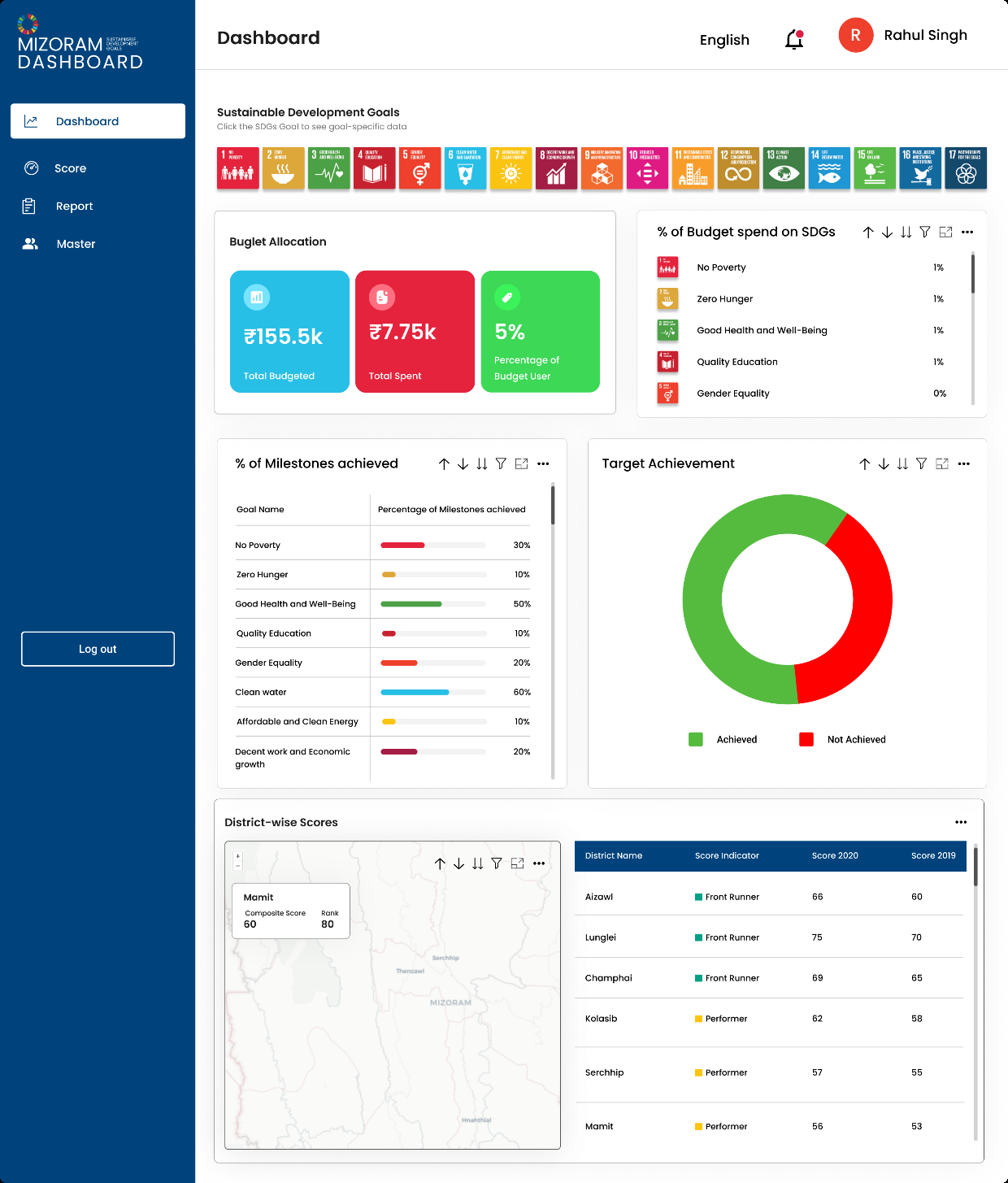 - **Phase II**: Enhanced features including village-level monitoring, advanced analytics, and mobile applications 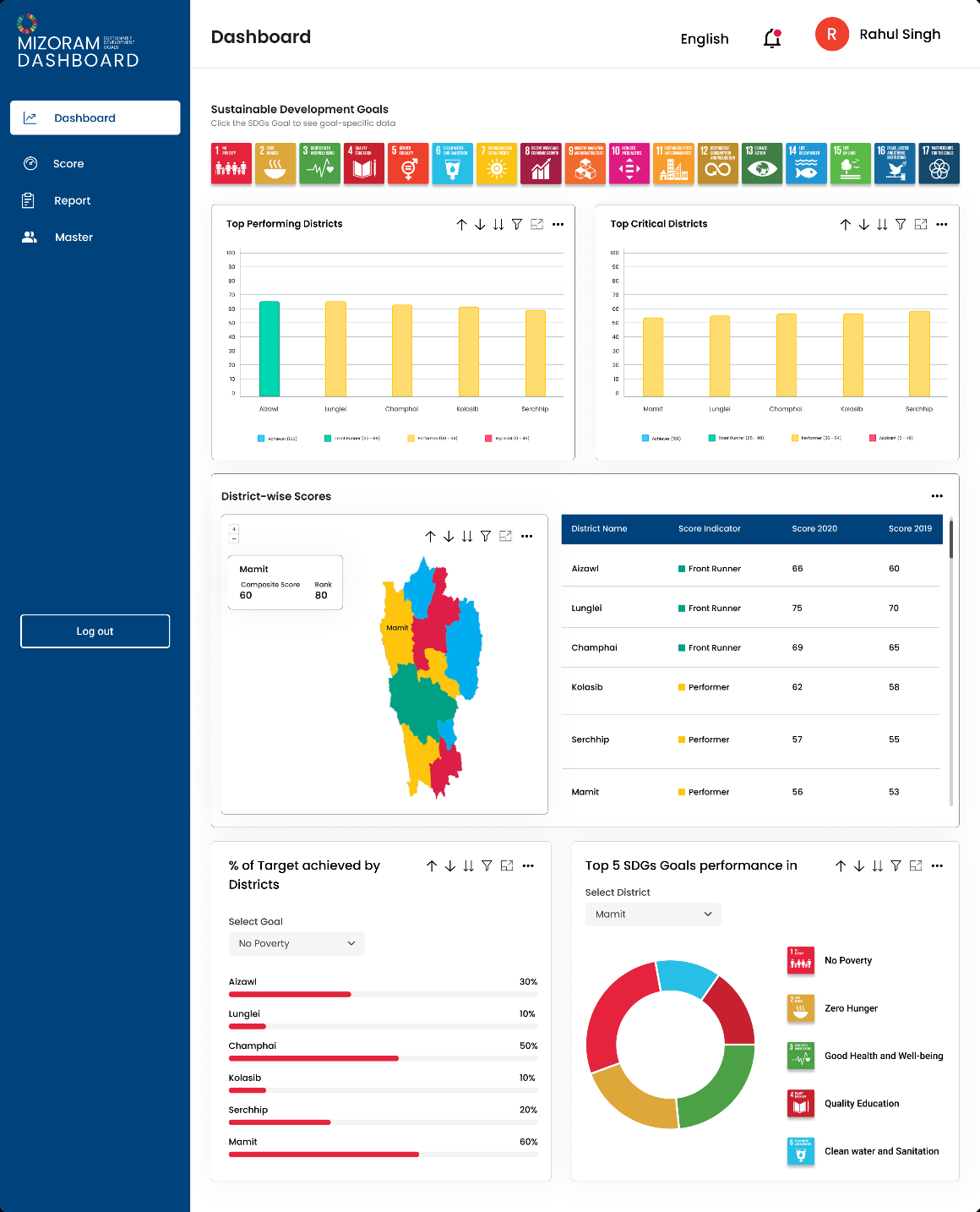 - **Phase III**: Full integration, API connections, advanced reporting, and optimization  **Technical & Documentation Deliverables** – System Requirement Specification (SRS) – Design documents with code structure – Database architecture with E-R diagrams – System manual (updated per version) – User manual (updated per version) – Security audit report – Application installation guide with infrastructure recommendations – Working copy of source code with data flow diagrams – Complete documentation of external dependencies – Open APIs documentation **Capacity Building** – Training of DES/District admin staff on data management and dashboard maintenance – Training of department/state officials on data input tools – Technical training/support to operationalize the software ### Technology Stack - **Web Application**: Open-source technologies with responsive design - **Mobile**: Native Android and iOS application development - **Frontend**: Interactive UI with data visualization libraries, geospatial mapping - **Backend**: Open-source framework with API integration capabilities - **Database**: Open-source RDBMS with hierarchical data management - **APIs**: RESTful APIs for external application integration - **Security**: Third-party security audit compliance - **Hosting**: Initial hosting by vendor with planned migration to NIC/government server ## Implementation Approach The project followed a four-phase delivery model over 12 months: 1. **Phase I – Foundation (30%)**: Core SDG Dashboard development with state and district level indicators, primary data entry functionality, and base visualizations. Beta version delivery within the first month. 2. **Phase II – Enhancement (30%)**: Extended functionality including village-level monitoring, mobile applications, advanced analytics, and comprehensive API integrations. 3. **Phase III – Optimization (30%)**: Full system integration, advanced reporting, performance optimization, user acceptance testing, and deployment on production infrastructure. 4. **Phase IV – Post-Deployment Support (10%)**: Maintenance and bug fixing, hosting services until deployment on NIC/government server, small customizations and changes, and technical training on a need basis. The project team comprised: – **Team Leader**: Post-Graduate/Graduate in IT with 7+ years in IT system development, strong knowledge in development sectors, project management, and team leadership. – **Product/Project Management Expert**: 5+ years with experience as UI developer, business analyst, frontend/backend developer, with full-stack capabilities. – **[Software Development](https://www.velsof.com/software-development/) Expert**: 4+ years specializing in IT system development, MIS, dashboard development, and mobile application development. – **Data Visualizer/Analyst**: Expertise in interactive data presentation and geospatial mapping. ## Key Outcomes & Impact - **Localized SDG Monitoring**: Established Mizoram as one of the leading states in SDG localization by enabling monitoring at state, district, ULB, and village levels — going significantly deeper than most state-level dashboards. - **Data-Driven Governance**: Empowered administrative secretaries and policymakers with real-time SDG progress data, enabling evidence-based course corrections and resource allocation. - **National Reporting Capability**: Provided a systematic mechanism for Mizoram to report SDG progress to NITI Aayog, strengthening the state’s contribution to India’s global SDG reporting. - **Field-Level Access**: Mobile applications enabled district administrators and field officials to access and contribute SDG data from anywhere in the state, critical for Mizoram’s geographically challenging terrain. - **Multi-Stakeholder Transparency**: The public-facing dashboard enhanced transparency, enabling citizens, external partners, and civil society to independently assess the state’s development progress. - **Foundation for CSR Integration**: The dashboard established the data infrastructure that would later power the CSR Matchmaking Platform, creating a comprehensive SDG-CSR ecosystem for Mizoram. ## Why Velocity Velocity was selected through UNDP’s competitive evaluation (70% technical, 30% financial) based on: - **End-to-End Technology Solution Experience**: Demonstrated expertise in managing complete technology solution development, deployment, and management for government and UN technology projects. - **Mobile Application Development**: Proven capabilities in both Android and iOS native application development, meeting the critical requirement for mobile SDG monitoring tools. - **Data Dashboard Excellence**: Track record in developing interactive, responsive web-based dashboards with complex data visualization requirements for government clients. - **Open-Source Technology Proficiency**: Deep expertise in open-source technologies with minimum 3 years of team experience in frontend UI development, backend development, full-stack development, and data visualization. - **API Integration Experience**: Demonstrated capability in building applications with API integrations to external platforms, essential for connecting with NITI Aayog’s national SDG dashboard. - **Government & UN Project Track Record**: Prior execution of data-driven dashboard projects for central/state governments, UN organizations, and international institutions. ### Related Services [iOS Development](/ios-development/)[Mobile App Development](/mobile-app-development/)[AI & Automation](/ai-automation/)