--- title: "AI in Social Media: Content Recommendation and User Behavior Analysis" url: https://www.velsof.com/blog/ai-in-social-media-content-recommendation-and-user-behavior-analysis/ date: 2026-02-13 type: blog_post author: Nishita Bisht categories: Blog tags: AI Algorithms, Artificial Intelligence, Facebook’s News Feed Algorithm, Social Media, social media platforms --- [Artificial Intelligence](https://www.velsof.com/ai-automation/) (AI) has revolutionized the way social media platforms operate. AI algorithms analyze user behavior, preferences, and engagement patterns to deliver a personalized experience. From TikTok’s addictive For You page to Instagram’s Explore tab, [AI-driven automation](/ai-automation/) powers the content discovery engine that keeps billions of users engaged every day. In this blog, we will explore two major applications of AI in social media: - Content Recommendation - User Behavior Analysis ## I. Content Recommendation Social media platforms generate enormous amounts of content daily. AI helps filter and recommend personalized content based on individual user behavior and interests. 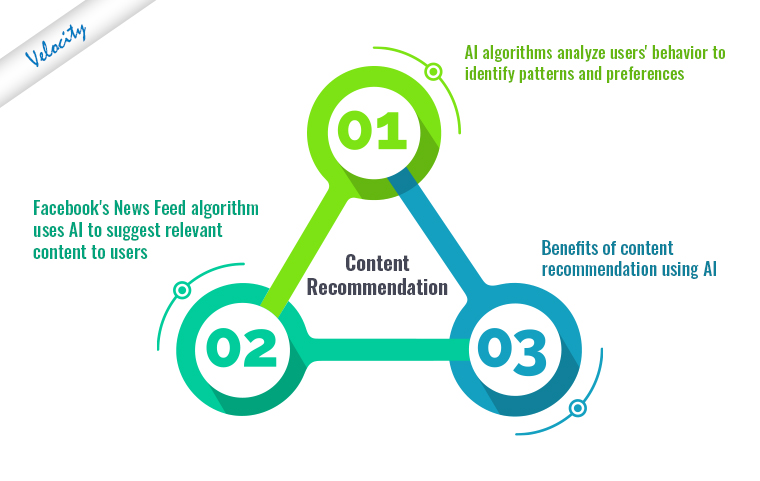 ### How AI Recommendation Algorithms Work At the core of every social media feed is a recommendation engine. These engines use several algorithmic approaches, often in combination: - **Collaborative filtering:** This approach analyzes what similar users have engaged with. If users A and B both liked posts X and Y, and user A also liked post Z, the algorithm will recommend post Z to user B. This is the same principle behind Amazon’s “customers who bought this also bought” feature. - **Content-based filtering:** The algorithm analyzes the attributes of content a user has engaged with (topics, hashtags, visual elements, text sentiment) and recommends similar content. If you frequently watch cooking videos, the algorithm learns to prioritize culinary content. - **Hybrid approaches:** Modern platforms combine both methods with deep learning models that process hundreds of signals simultaneously — from the time you spend hovering over a post to whether you watch a video with sound on or off. ### AI Algorithms Analyze User Behavior AI systems evaluate: - Content users like, comment on, and share - Type of posts engaged with (videos, reels, articles, etc.) - Engagement frequency - Recency of interaction - Dwell time — how long a user pauses on content before scrolling - Negative signals — content skipped, hidden, or reported By identifying patterns in behavior, algorithms determine what content is most relevant to each user. ### How Major Platforms Use AI **TikTok’s For You Page:** TikTok’s recommendation engine is widely regarded as the most sophisticated in social media. It uses a combination of video information (captions, hashtags, sounds), device and account settings, and — most importantly — user interaction data. TikTok’s algorithm is so effective that it can personalize a new user’s feed within minutes of initial usage. **Instagram Explore:** Instagram’s Explore tab uses machine learning to categorize content into topics and match them with user interests. The algorithm considers the accounts a user follows, the posts they have liked, and the type of content they engage with most frequently. **YouTube Recommendations:** YouTube’s recommendation system drives over 70% of watch time on the platform. It uses a two-stage architecture — a candidate generation model that selects hundreds of potential videos, followed by a ranking model that orders them by predicted engagement. **Facebook/Meta News Feed:** Facebook’s algorithm uses machine learning to personalize content for every user. It considers past interactions, engagement history, relationship strength, and content type preference. By analyzing these factors, Facebook ensures users see content that aligns with their interests. ### Benefits of AI-Powered Content Recommendation - Increased engagement with personalized content - Improved user experience - Higher retention rates - Increased time spent on the platform - Better content discovery for creators and publishers Personalization keeps users connected and active. ## II. User Behavior Analysis AI is also used to analyze user behavior to understand preferences, interests, and activity patterns. This analysis goes far beyond simple metrics — modern AI systems build comprehensive behavioral models that predict future actions. [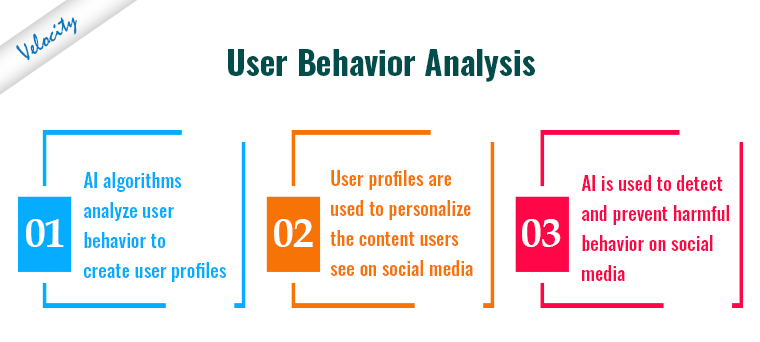](https://www.velsof.com/wp-content/uploads/2023/05/User-Behavior-Analysis.jpeg) ### Key Analysis Techniques **Sentiment analysis:** Natural Language Processing (NLP) models analyze the tone and emotion in user comments, posts, and messages. Platforms use this to gauge public opinion on topics, detect negative experiences, and identify trending sentiments in real time. Brands leverage sentiment analysis to monitor how customers feel about their products and services. **Engagement pattern modeling:** AI tracks how users interact with different content types across time — when they are most active, what content formats they prefer at different times of day, and how their interests evolve over weeks and months. This data informs content scheduling and delivery optimization. **Predictive modeling:** Machine learning models predict user behavior before it happens. They forecast which users are likely to churn, which content will go viral, and which ads a user is most likely to click on. These predictions drive everything from notification timing to ad placement. ### Creating User Profiles Using AI AI systems evaluate: - Content interaction patterns - Preferred content formats - Active hours of usage - Device and platform behavior - Social graph connections and influence scores - Purchase intent signals and conversion behavior This data helps create detailed user profiles that power personalization across the platform. ### Personalized Content Delivery User profiles allow platforms to: - Suggest relevant posts and stories - Recommend accounts or pages to follow - Deliver targeted advertisements - Optimize content timing for maximum engagement Understanding user preferences enhances overall experience. ### Detecting Harmful Behavior AI plays a crucial role in maintaining platform safety. AI algorithms can detect: - Cyberbullying patterns - Hate speech and extremist content - Spam activity and bot networks - Fake news dissemination - Coordinated inauthentic behavior (fake accounts acting together) Moderators use AI-generated insights to take corrective action and maintain a safe digital environment. Meta reported that in 2024, AI proactively detected and removed over 95% of hate speech on Facebook before any user reported it. ## III. Ethical Considerations While AI-powered social media delivers remarkable personalization, it raises important ethical questions that businesses and users should understand: ### Filter Bubbles and Echo Chambers When algorithms optimize purely for engagement, they tend to show users content that reinforces their existing beliefs. This creates filter bubbles — isolated information environments where users are rarely exposed to diverse perspectives. Platforms are increasingly aware of this issue and are experimenting with features that introduce content diversity. ### Data Privacy Behavioral analysis requires collecting vast amounts of personal data. Regulations like GDPR in Europe and CCPA in California have forced platforms to be more transparent about data collection and give users greater control. However, the tension between personalization and privacy remains one of the defining challenges of the AI era. ### Algorithmic Bias AI models trained on historical data can perpetuate existing biases. Recommendation algorithms may under-represent content from minority creators or amplify sensational content over factual reporting. Responsible AI development requires continuous auditing and bias mitigation strategies. ## IV. Business Applications For businesses, understanding AI in social media is not just academic — it directly impacts marketing strategy and customer engagement: - **Targeted marketing:** AI-driven audience segmentation allows businesses to reach precisely the right customers with the right message at the right time, dramatically improving ad ROI. - **Customer insights:** Social listening tools powered by AI analyze thousands of conversations to reveal customer pain points, preferences, and emerging trends before they become mainstream. - **Content strategy:** AI analytics help content creators and marketers understand which topics, formats, and posting schedules drive maximum engagement for their specific audience. - **Influencer identification:** AI tools can identify micro-influencers whose audience demographics align with a brand’s target market, enabling more authentic and cost-effective partnerships. ## V. Future Trends in AI-Driven Social Media The intersection of AI and social media continues to evolve rapidly. Key trends to watch include: - **Generative AI content:** AI-generated text, images, and videos are becoming indistinguishable from human-created content. Platforms are developing detection tools and labeling requirements to maintain transparency. - **Multimodal understanding:** Next-generation AI models process text, images, video, and audio simultaneously, enabling much richer content understanding and more nuanced recommendations. - **Decentralized social media:** Platforms like Mastodon and Bluesky offer algorithmic transparency and user control over recommendation algorithms — a direct response to concerns about centralized AI control. - **Real-time personalization:** Edge computing and faster AI models are enabling content personalization in real time, adapting feeds dynamically based on a user’s current context and mood. - **AI-powered customer service:** Social media is increasingly the first point of contact for customer support, with AI chatbots handling initial interactions and routing complex issues to human agents. ## Conclusion AI has transformed social media platforms by enabling intelligent content recommendation and advanced user behavior analysis. From collaborative filtering algorithms that power TikTok’s viral discovery engine to sentiment analysis models that protect platform safety, AI is the invisible engine driving modern social media. Key impacts include: - Personalized content delivery at unprecedented scale - Improved engagement rates through predictive modeling - Enhanced user experience via behavioral understanding - Detection and prevention of harmful behavior - Powerful business intelligence for marketers and brands As AI continues to evolve, social media platforms will become even more intelligent, efficient, and user-centric. Businesses that understand and leverage these AI capabilities will have a significant competitive advantage in reaching and engaging their audience. Looking to integrate AI-driven solutions into your business? [Explore our AI and automation services](/ai-automation/) or [contact our team](/contact-us) for a consultation. ### Related Services [AI & Automation](/ai-automation/)